
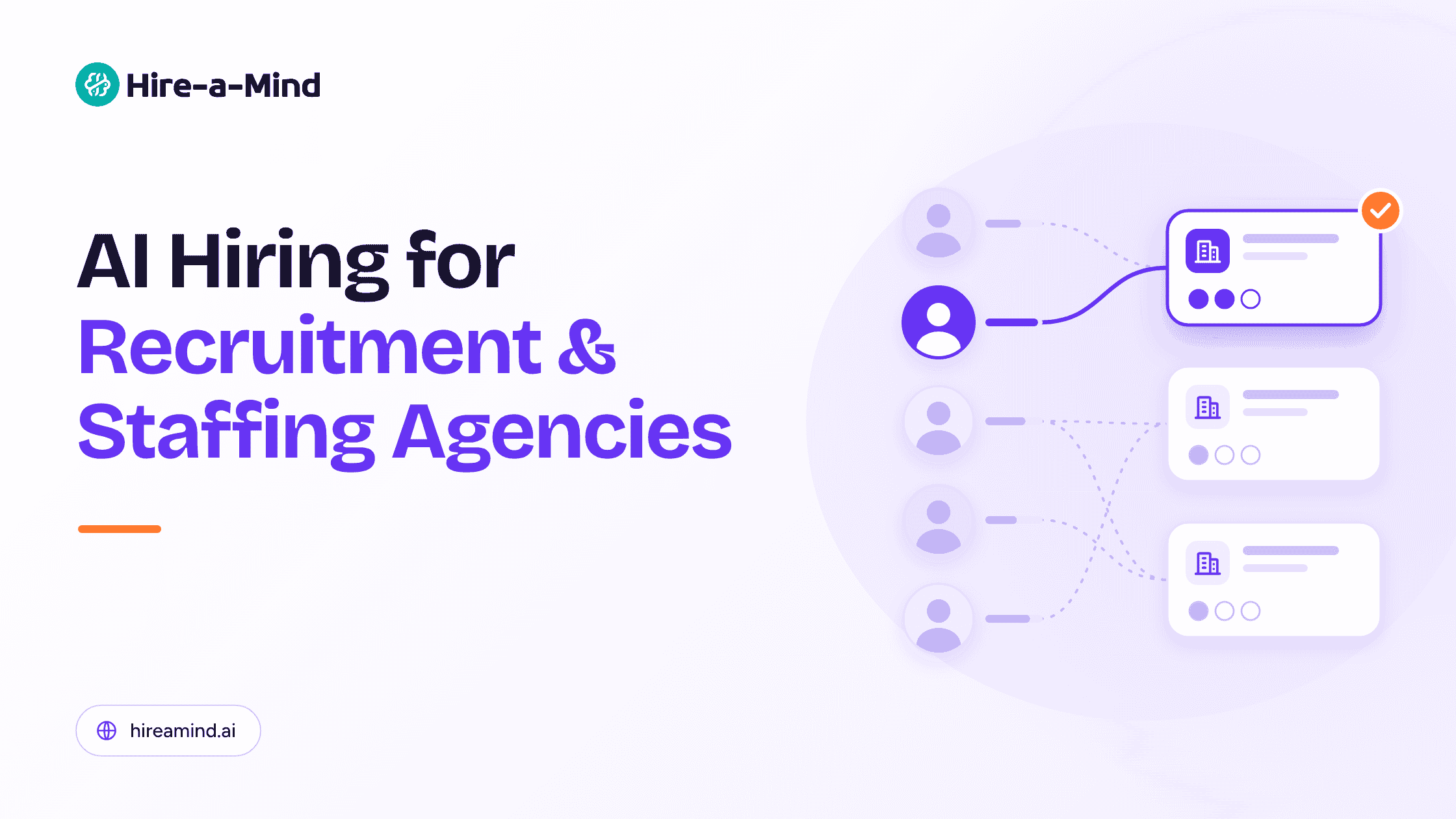
AI Hiring for Recruitment & Staffing Agencies: What It Should Actually Do
Learn how AI hiring helps recruitment and staffing agencies handle more roles, screen CVs, run interviews and make evidence-backed client recommendations.
AI Hiring9 min read
On this page
Recruitment agencies rarely have a one-role, one-recruiter problem. They manage multiple requisitions for multiple clients, each with different requirements, while new roles keep arriving and clients expect qualified candidates quickly. AI hiring should help agencies absorb that volume without increasing human workload at the same rate, with recruiters still making every decision.
Good AI hiring should increase recruiter leverage, not remove recruiter judgment.
What is AI hiring for recruitment agencies?
AI hiring for recruitment agencies is the use of AI across screening, interviewing and candidate evaluation to increase hiring capacity while keeping recruiters responsible for review and final decisions.
Instead of using AI for a single task, agencies can use it across several stages of the hiring process, from the first CV to the client recommendation. The agency's advantage is not simply finding candidates. It is finding the right candidates quickly, and being able to explain why they are right.
Why does AI hiring matter more for agencies?
AI hiring for staffing agencies matters because an agency may have dozens of open roles at once, each with its own client requirements and candidate pool. A recruiter reviews sourced profiles and CVs, shortlists, holds first-round conversations, coordinates technical interviews, collects feedback and writes a client-ready recommendation, while another client already wants the next shortlist.
Many agencies work mostly by headhunting, so the pressure is less a flood of applications than many sourced profiles across many roles, each needing a fresh read against different criteria. Where a role does attract applicants, the same applies.
- Continuous hiring: roles arrive unpredictably, and the agency has to absorb them.
- Multiple clients: each has its own criteria, hiring managers and expectations.
- Speed to submittal: a qualified shortlist has to reach the client quickly.
- Many candidate pools: headhunted, referred and applied candidates all need the same rigor.
- Client scrutiny: the agency is selling its judgment, and the client will test it.
So the question is not simply how to recruit faster. It is how to increase hiring capacity without increasing operational overhead at the same rate. If an agency suddenly has dozens of active requisitions, how can it increase throughput without adding the same number of recruiters, coordinators and interviewers?
What should AI hiring actually do for an agency?
Eight capabilities describe the model, independent of any product.
1. Handle Continuous Hiring Volume
A new client role can arrive today and ten more next week. AI can help an agency absorb that: review sourced profiles and CVs across many roles at once, prioritize candidates, apply consistent criteria, take on repetitive recruiter work, process more candidates simultaneously and keep several requisitions moving together. The goal is more candidates processed per recruiter without lowering screening quality. AI should surface relevant candidates with the evidence to review them, not simply reject people.
2. Screen Candidates Against the Client's Actual Criteria
A recruiter cannot rely on one generic checklist. AI should understand the role, identify required and preferred criteria, evaluate profiles and CVs against them, rank candidates, surface supporting evidence, flag gaps and route uncertain cases to human review. The AI should evaluate against the role, not against a generic definition of a good candidate.
3. Preserve the Context Behind Every Candidate
A CV does not explain why a recruiter approached or chose this person. Clients often receive a CV, a recruiter summary and maybe interview notes, and the reasoning can become subjective. AI hiring should keep the context behind each recommendation. An illustrative example:
- Client requirement: 5+ years of backend engineering experience.
- Candidate evidence: 6 years building distributed systems with Java and Spring.
- Interview evidence: described designing fault-tolerant services.
- Recruiter recommendation: strong technical fit; probe leadership experience further.
That is a stronger client-facing recommendation than "Strong candidate. Please review." It turns a profile into an evidence-backed candidate story. An agency is not merely sending candidates; it is selling its judgment, and evidence is what makes that judgment visible.
4. Run AI First-Round Interviews
Recruiters spend substantial time on the same opening questions: experience, motivation, recent projects, availability, expectations. AI can run these as structured first-round interviews. Candidates interview on their own schedule, everyone gets the same structure, responses are transcribed and scored against role criteria, and recruiters focus on the people who progress. AI first-round interviews should remove repetitive interviewing, not human interviewing.
5. Run Technical Interviews Without Increasing Interviewer Overhead
Clients often want technical validation, but agencies may have limited access to software engineers, data analysts, DevOps engineers, security or finance specialists, and every technical interview adds coordination overhead. AI technical interviews can run structured conversations against predefined role criteria. The interviewer or hiring team sets the questions and assessment criteria. For a software engineer that could mean fundamentals, problem solving, system design, tools and communication; for a data analyst, SQL, analytical reasoning, statistics, business interpretation and communication.
The agency can increase early technical screening capacity without a subject-matter expert in every initial conversation. AI does not replace expert interviewers: it handles structured early-stage assessment, while human experts stay responsible for deeper validation and final judgment where needed.
6. Connect AI and Human Interviews
A candidate may move from CV to AI interview to technical interview to hiring manager interview, and these stages often become disconnected. A good AI hiring workflow keeps the context, so candidates are evaluated consistently and evidence from every stage is preserved. An illustrative example:
- CV: 5 years of Python experience.
- AI interview: strong Python fundamentals.
- Technical interview: the human interviewer finds a weakness in system design.
- Final evaluation: the recruiter sees the complete picture.
The value of AI increases when every stage adds evidence to the same candidate evaluation rather than creating another isolated scorecard.
7. Make Candidate Recommendations Easier to Explain to Clients
Agencies make recommendations to another organization, which raises the value of evidence. A client may ask why a candidate was shortlisted, how they match the role, what their strengths and risks are, what they showed in the interview and how they compare with the others. AI hiring should make those answers easier: from "Here is the CV" to "Here is the CV, how it matches the role, what the candidate demonstrated in the interview, where the gaps are, and why we recommend moving forward." The value of AI hiring for an agency is therefore not simply saving recruiter time. It is helping the agency produce a better, more defensible client deliverable.
8. Keep Humans in Control
AI should: process, structure, summarize, score, surface evidence, identify gaps and recommend.
People should: review, challenge, interview, validate, make the decision, communicate with clients and make the offer.
AI should not:
- reject candidates automatically without human oversight
- make final hiring decisions
- replace expert judgment on complex roles
- hide why a candidate received a score
- treat every role with the same generic criteria
- turn interviews into black-box scores
The AI recommends. People decide. Good AI hiring workflows make the recruiter more informed and more efficient, not less accountable.
What does this look like in practice?
Take an illustrative scenario: a staffing agency is hiring 10 software engineers for a client. The client needs 5+ years of experience, Java and Spring, SQL, cloud experience and strong communication. For one opening, the agency might work through a pool of 300 sourced profiles and CVs, whether headhunted, referred or applied. These numbers are illustrative, not a benchmark.
Illustrative funnel for one opening (not a benchmark)
- Sourced profiles and CVs: 300
- After AI screening against the client's criteria: 50 relevant
- After AI first-round interviews: 15
- After technical screening: 6 finalists
- After human interviews: 3 recommended to the client
- Outcome: 1 hire
How the same work changes with and without AI
- Screening
- Without AI: Recruiters read every profile and CV by hand
- With AI-assisted hiring: AI screens against the client's criteria and ranks; recruiters review
- First-round interviews
- Without AI: Recruiters repeat the same questions
- With AI-assisted hiring: Interviews run asynchronously with a consistent structure
- Technical screening
- Without AI: Scarce experts join every early conversation
- With AI-assisted hiring: Technical screening capacity increases; experts focus on later-stage candidates
- Evidence
- Without AI: Scattered across CVs, notes and chats
- With AI-assisted hiring: Structured and linked to each stage
- Client recommendation
- Without AI: Relies heavily on recruiter notes
- With AI-assisted hiring: Easier to explain, with evidence behind it
The difference is not that people disappear. It is where their time goes. Without AI, more roles mean proportionally more manual work, and eventually more headcount. The aim with AI is more roles, more AI-assisted throughput, and recruiters spending time on relationships, judgment and clients. That is recruiter leverage rather than generic cost savings, and no productivity statistic is claimed here.
How does Hire-a-Mind bring this together?
This is the model Hire-a-Mind is built around: not simply automating one recruiting task, but connecting the evidence across the hiring workflow.
Hire-a-Mind is built around a simple idea: the criteria used to define a role should remain connected to the evidence collected throughout the hiring process. A role is defined once. Those weighted criteria then drive CV screening, AI Interviews, human interviews, a cumulative evaluation and the final decision. The result is one hiring standard, evidence across every stage and one decision record.
The flow is role criteria → CV evidence → AI Interview evidence → human interview evidence → cumulative evaluation → final decision.
- Beacon: defines the client's role, ideal candidate profile and weighted criteria. Beacon is free forever.
- Sift: screens CVs, uploaded or received through an application link, against those criteria and shows the CV lines behind each score, ready to share with a client. AI never rejects a candidate.
- Scout: runs structured text or voice AI Interviews against the same criteria, with each score linked to the transcript.
- Human interviews on Google Meet: continue the evaluation using the same criteria, with the transcript assessed against them.
- Evaluation: combines stage scores, cited evidence, reviewer notes and finalist comparison into one decision record.
What matters is the carry-through: the weighted criteria and the evidence travel with each candidate from CV screening through AI Interviews and human interviews into a cumulative evaluation, instead of each stage producing an isolated scorecard.
The AI recommends. People decide. AI never rejects anyone. Your team makes the hiring decision, approves offers and contacts candidates. Hire-a-Mind publishes volume-based pricing rather than per-seat pricing, with Free, Starter, Growth and Enterprise plans. See pricing
What should good AI hiring ultimately deliver?
The end goal is not "we used AI." It is: we can give our client a stronger shortlist, faster, with evidence behind every recommendation. Done well, AI hiring improves speed, throughput, consistency, interview capacity, evidence quality, client communication and recruiter leverage.
For a recruitment agency, AI hiring is not about replacing recruiters. It is about giving recruiters the capacity to handle more hiring volume while producing stronger, more explainable candidate recommendations.
To go deeper, read What Is an AI-Powered Hiring Platform?, Hiring Intelligence: How a Connected Hiring Workflow Works, How to Connect an AI-Powered Hiring Platform to Your ATS Without Creating More Work and The End of Gut-Feeling Hiring, or see how AI Interviews work.
Running many roles for many clients? Start with one client role.
Screen CVs and sourced profiles, run AI Interviews, continue with human interviews, and see how the evidence comes together before you make your recommendation.
The AI recommends. People decide.
Frequently asked questions
What is AI hiring for recruitment agencies?
- It is the use of AI across screening, interviewing and candidate evaluation to increase hiring capacity while keeping recruiters responsible for review and final decisions. For agencies, it helps handle many roles and clients at once and turns each recommendation into evidence the client can review.
How can AI help staffing agencies handle many open roles at once?
- By applying consistent, role-specific criteria to sourced profiles and CVs across every requisition, running structured first-round interviews on candidates' schedules, and keeping each candidate's evidence in one place. Recruiters then spend their time on review, client conversations and decisions instead of repeating each stage by hand.
Can AI screen sourced profiles and CVs for a recruitment agency?
- Yes. AI can score each profile or CV against the client's criteria and show the evidence behind the score, whether the candidate was headhunted, referred or applied. Good screening does not reject automatically: low scores should route to a person. In Hire-a-Mind, Sift works this way and AI never rejects a candidate.
Can AI conduct first-round interviews?
- Yes. AI can run structured first-round interviews with the same questions for every candidate, taken on the candidate's schedule, with answers transcribed and scored against the role's criteria. It should remove repetitive interviewing, not human interviewing. In Hire-a-Mind, Scout runs these by text or voice.
Can AI conduct technical interviews?
- Yes. Scout, Hire-a-Mind's AI interviewer, can conduct technical interviews because the interviewer or hiring team sets the questions and assessment criteria. Each answer is scored against those criteria. People review the results and make the decision; AI does not replace expert interviewers or final judgment on complex roles.
Does AI replace recruiters?
- No. AI processes, structures, summarizes, scores and surfaces evidence. Recruiters review, challenge, interview, decide, speak to clients and make the offer. AI does the structured, repeatable work; relationships, judgment and accountability stay with people. The goal is recruiter leverage: more roles handled with stronger evidence, with people accountable for every decision.
How can recruitment agencies explain AI-assisted candidate recommendations to clients?
- Share the evidence, not just a score: how the candidate matches the client's criteria, the CV lines and interview moments behind each score, where the gaps are and why you recommend moving forward. A cumulative evaluation that links every score to its source makes those answers easier to give.
Can AI hiring work with an existing ATS?
- Often, yes. An ATS or CRM usually stays the system for clients, jobs and placements, while an AI hiring workflow handles screening, interviews and evaluation. How well they work together depends on the platform and the integration available, so ask any vendor how candidate, role and decision data move between systems, and agree which one holds the final decision record.
What should a recruitment agency look for in AI hiring software?
- Criteria set per role and client, scores that show their evidence, no automatic rejection, structured AI interviews that connect to human interviews, one cumulative evaluation across stages and a clear decision record. Also check how it fits your ATS and whether pricing follows seats or hiring volume.
How does Hire-a-Mind use AI for recruitment agencies?
- Beacon turns a client's role into weighted criteria, Sift screens CVs against them, Scout runs AI Interviews by text or voice, human interviews run on Google Meet, and Evaluation brings scores and cited evidence from every stage into one decision record. The AI recommends. People decide.
- AI Hiring
- AI Recruiting
- Recruitment Agencies
- Staffing Agencies
- Hiring Intelligence
- Hire-a-Mind
- AI Interviews
- AI Candidate Screening
Keep reading
All articles
AI Hiring
Metaview Alternatives in 2027: From Interview Intelligence to Full Hiring Workflows
Looking for Metaview alternatives? Compare BrightHire, Hire-a-Mind, Manatal, HireVue and meeting-intelligence tools by workflow, AI interviews, evaluation.
Interview Intelligence
Best Interview Note-Taker Tools vs Hire-a-Mind: Notes or a Connected Hiring Workflow?
Interview note-taker tools in 2027 compared: Metaview, BrightHire, Fireflies, Otter, Fathom and more, vs Hire-a-Mind's connected hiring workflow.
AI Hiring
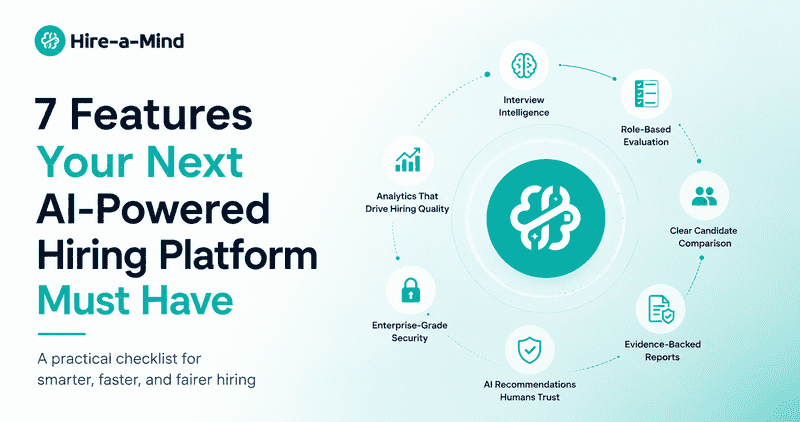
Checklist: 7 Features Your Next AI-Powered Hiring Platform Must Have
Choosing an AI-powered hiring platform? Discover the 7 essential features that help hiring teams evaluate candidates better and make evidence-based hiring decisions.