
Metaview Alternatives in 2027: From Interview Intelligence to Full Hiring Workflows
Looking for Metaview alternatives? Compare BrightHire, Hire-a-Mind, Manatal, HireVue and meeting-intelligence tools by workflow, AI interviews, evaluation.
AI Hiring11 min read
On this page
- What are the main Metaview alternatives in 2027?
- Why do teams look for a Metaview alternative?
- What does Metaview do well?
- Which Metaview alternative fits which job?
- How do Metaview, BrightHire and Hire-a-Mind connect hiring stages?
- What does Hire-a-Mind do differently?
- Who should consider a connected hiring workflow?
- When Hire-a-Mind may not be the right fit
- When Metaview may still be the better fit
- When you need both
- How we compared these tools: methodology and disclosure
- Frequently asked questions
Teams look for Metaview alternatives for different reasons: a different interview-intelligence approach, an ATS-first workflow, assessment-led hiring, AI interviews, or a connected process that carries the same criteria and evidence across every stage. Metaview has expanded beyond interview notes, so the useful question is which hiring architecture fits the way your team works.
A hiring platform can capture conversations, automate stages, or connect the evidence across them. The difference is what happens before and after the interview.
Disclosure: Hire-a-Mind publishes this article and is one of the products compared. We don't score or rank products. Details come from each vendor's own website, and prices were checked on 12 November 2026 and may change. See how we compared these tools below.
What are the main Metaview alternatives in 2027?
Metaview is no longer one thing. It now describes itself as an Agentic Recruiting Platform. The question is not whether it can cover more than interviews, but how its recruiting-agent model compares with other ways of organizing the hiring process and carrying evidence through it. The useful comparison is hiring architecture: which model fits your process, where your evidence lives, and how it moves from one stage to the next.
Metaview alternatives in 2027 at a glance
- Metaview (reference)
- Type: Agentic recruiting platform: sourcing, application review, screening, notes, reports
- Fit (not a ranking): Agentic recruiting across the funnel, with interview capture on video, phone and in-person
- Published pricing: Notetaker: Free $0 (25 calls/mo), Pro $60/user/mo. Application Review: Free (50/mo), Pro $150/mo. Platform on request
- BrightHire
- Type: AI hiring platform: application review, AI interviews, live interview intelligence
- Fit (not a ranking): An AI layer across the funnel, deeply integrated with your ATS
- Published pricing: On request (priced per product)
- Hire-a-Mind
- Type: Connected hiring workflow built around cumulative evaluation across AI and human stages
- Fit (not a ranking): Teams that want criteria, screening, interviews and the decision in one record
- Published pricing: Published, volume-based (Free, Starter, Growth, Enterprise)
- Manatal
- Type: ATS and recruitment CRM with AI capabilities
- Fit (not a ranking): Agencies and teams that need an ATS first
- Published pricing: Professional $15, Enterprise $35, Enterprise Plus $55 per user/mo billed annually ($19, $39, $59 monthly). Custom on request
- HireVue
- Type: Enterprise interviewing and assessments platform
- Fit (not a ranking): Teams where validated assessments and structured, high-volume screening dominate
- Published pricing: On request
- Fireflies, Otter, Fathom
- Type: General meeting-intelligence platforms used in recruiting
- Fit (not a ranking): Teams whose main need is capturing, transcribing and analyzing conversations
- Published pricing: Free plans; paid per-seat plans
Prices as shown on each vendor's pricing page on 12 November 2026, in USD. They may change or vary by region, billing period or promotion.
Why do teams look for a Metaview alternative?
Reasons vary, and most are about workflow fit, not product quality:
- A different hiring architecture: weighted criteria that carry through screening, AI interviews, human interviews and final evaluation.
- An ATS-first workflow: the system of record is the starting point, with AI added around it.
- Assessment-led hiring: validated skills tests or simulations are central to the process.
- AI-interview-first screening: automated first-round interviews anchor the funnel.
- A different pricing model: per-user, per-product or volume-based pricing, depending on how your hiring runs.
- A different evidence model: CV, AI interview and human interview evidence roll into a cumulative evaluation.
None of these is a deficiency in Metaview; each is a reason to choose a different architecture.
What does Metaview do well?
Metaview is now much broader than interview intelligence. It positions itself as an agentic recruiting platform spanning sourcing, application review, AI screening, interview notes and reporting, with agents sharing context across the hiring funnel, from initial sourcing to final offer. It is a credible choice for teams that want that model. Its Notes product captures interviews on Google Meet, Teams, Webex and Zoom, plus phone and in-person meetings, with or without a bot, and posts notes and completed scorecards to the candidate's ATS record.
Its Screening agent is an AI voice interview that candidates take on their own time, scored against your rubric, with a human making the final decision. Application Review evaluates applications against an Ideal Candidate Profile built from your job description, which Metaview says it refines from sourcing feedback, application review outcomes and interview results. Sourcing, outreach and reporting agents sit alongside.
Pricing is by product, as in the table above; the full platform is on request.
Which Metaview alternative fits which job?
BrightHire: interview intelligence, AI interviews and application review
BrightHire describes itself as "the AI hiring platform" and as "one hiring system, from first application to final decision": an AI-native layer, deeply integrated with your ATS, covering application review, AI interviews, live interview intelligence and fraud detection at each step. It comes as three products you can buy separately or together. Inbound reviews applications against a rubric drafted from your job description. Screen runs two-way AI interviews by voice or video. Interview Intelligence gives live interviews real-time guides, AI notes and scorecards auto-filled for one-click submission to your ATS. It works with Greenhouse, Lever, Ashby, Workday and more, and with Zoom, Teams and Google Meet. Each product is priced separately: Inbound by applicant volume, Screen by interview volume and Interview Intelligence by company size, all on request.
- Who it's for: teams that want an AI layer across application review, AI interviews and live interviews, with the ATS as system of record.
- Who it's not for: teams that want to compare published prices before talking to a vendor.
Manatal: when an ATS is the job
Manatal is an ATS and recruitment CRM, and ATS-first is its strength: a customizable pipeline, job posting to 2,500+ job boards and AI recommendations that score candidates against job requirements. Its AI Interviewer add-on offers automated screening in English, French, German, Spanish, Italian and Portuguese. Pricing is per user, as in the table above, with a 14-day free trial and a Custom plan on request.
- Who it's for: recruitment agencies, headhunters and HR teams that first need one place for jobs, candidates, clients and placements.
- Who it's not for: teams whose main gap is live interview capture; the Manatal pages we reviewed don't describe a live-interview notetaker.
HireVue: when assessments dominate
HireVue is an enterprise interviewing and assessment platform, and assessments are its strength: job-relevant skills tests, game-based assessments, simulations and coding exercises. Its site also describes an AI Interviewer for 24/7 voice screening, video interviewing and an interview co-pilot for live Zoom or Teams interviews. Pricing is available by requesting a demo.
- Who it's for: enterprises and high-volume employers where validated assessments and structured screening are the main signal.
- Who it's not for: teams that want published prices or live-interview notes first.
Fireflies, Otter and Fathom: better for meeting intelligence
These platforms can work well when the primary need is capturing, transcribing and analyzing conversations. They become a weaker fit when the hiring team needs role criteria, multi-stage evaluation and a single decision record connected across the hiring process.
- Fireflies lists Recruiting among its use cases. Pro is $10 per seat per month billed annually ($18 monthly).
- Otter lists sales, education and media use cases. It has a free Basic plan; Pro is $16.99 per user per month billed monthly.
- Fathom has an HR & Talent use case for streamlining interviews and evaluating candidates with Ask Fathom, and AI Scorecards on its Business plan. It has a free plan; Team is $15 per user per month billed annually ($19 monthly), Business $25 ($34).
Who they're for: teams whose primary need is capturing, transcribing and analyzing conversations, including interviews. Who they're not for: teams that need role criteria, multi-stage scorecards and a connected decision record.
How do Metaview, BrightHire and Hire-a-Mind connect hiring stages?
All three connect several hiring stages and carry context between them: Metaview through shared agent context and its Ideal Candidate Profile, BrightHire through application review, AI interviews and live interviews in one system, Hire-a-Mind through cumulative evaluation. They differ in where the center of gravity sits. Details are as published on 12 November 2026.
Hiring stages and evidence flow
- Role criteria
- Metaview: Ideal Candidate Profile built from your job description and refined from feedback and hiring decisions
- BrightHire: Rubric drafted from your job description (Inbound)
- Hire-a-Mind: Beacon role definition and weighted criteria, carried into every later stage
- CV and application screening
- Metaview: Application Review
- BrightHire: BrightHire Inbound
- Hire-a-Mind: Sift ranks every CV with the CV lines behind each score; AI never rejects
- AI first-round interviews
- Metaview: Screening agent (AI voice)
- BrightHire: BrightHire Screen (voice or video)
- Hire-a-Mind: Scout runs AI Interviews by text or voice, on the candidate's schedule
- Live interview capture
- Metaview: Video, phone and in-person; Meet, Teams, Webex and Zoom
- BrightHire: Live interviews on Zoom, Teams and Google Meet
- Hire-a-Mind: Human interviews on Google Meet via Google Workspace; transcripts generated and assessed
- Evaluation model
- Metaview: Recruiting context, scorecards and agent feedback across the funnel
- BrightHire: Rubrics, interview intelligence and talent insights
- Hire-a-Mind: Explicit cumulative stage evaluation with cited evidence and finalist comparison
- Final decision
- Metaview: A human decides
- BrightHire: Recruiters and hiring managers decide
- Hire-a-Mind: People decide; one decision record
- Pricing model
- Metaview: By product and agent; platform on request
- BrightHire: By product; on request
- Hire-a-Mind: Published, volume-based
- Best fit (not a ranking)
- Metaview: Agentic recruiting workflow with strong interview capture
- BrightHire: AI layer across application review, AI interviews and live interviews, with your ATS
- Hire-a-Mind: Cumulative evaluation across AI and human interview stages
Pricing models differ: Metaview prices by product and agent, BrightHire by product, Manatal per user and Hire-a-Mind by hiring volume. Compare billing units, not just headline prices.
What does Hire-a-Mind do differently?
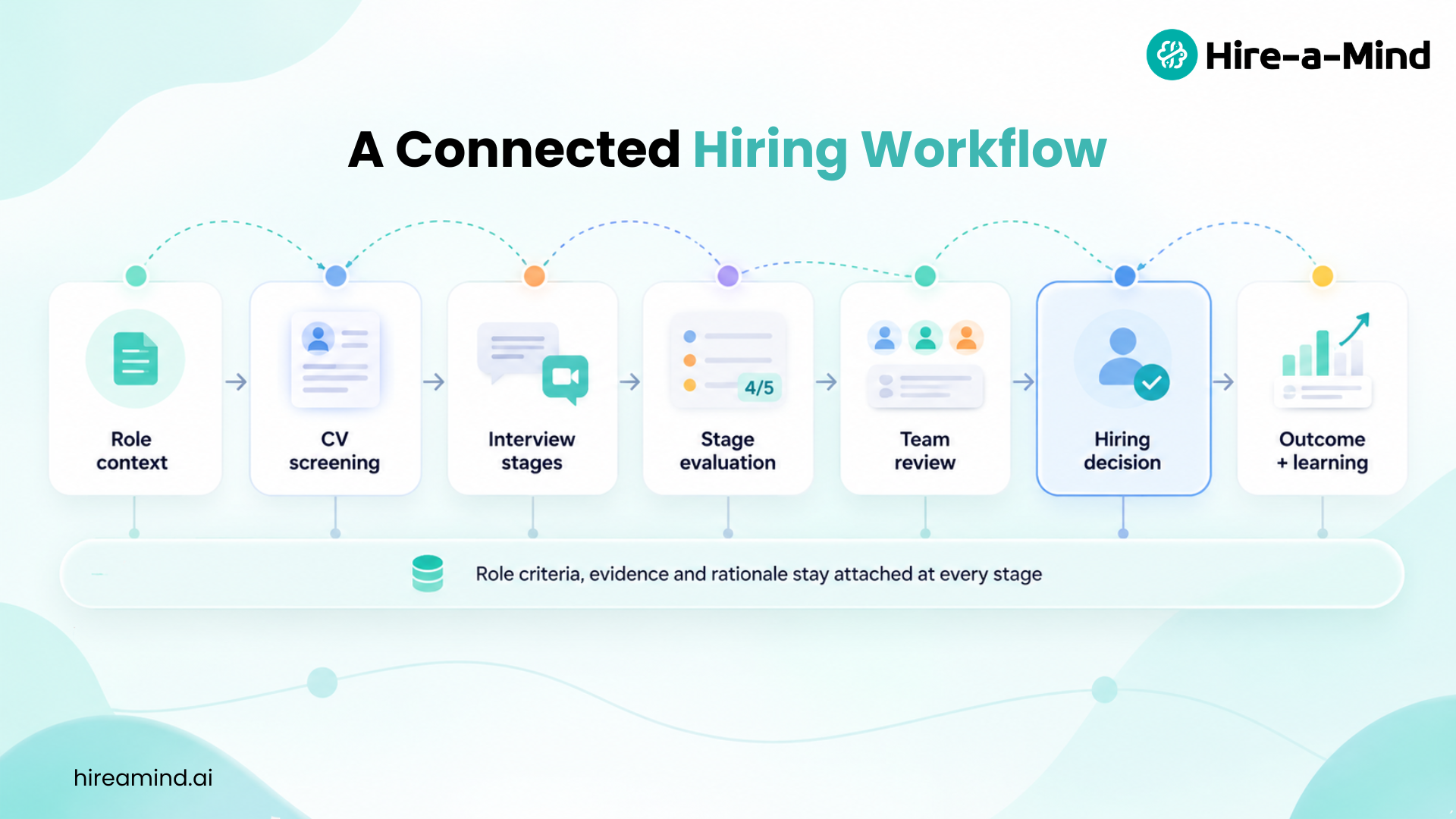
Hire-a-Mind is a hiring intelligence platform that connects every step of hiring with evidence. It is designed around a cumulative hiring evaluation: define the role and weighted criteria once (one hiring standard), assess candidates through CV screening, AI Interviews and human interview stages, then bring the evidence and scores together into one decision record.
The flow is role criteria → CV evidence → AI Interview evidence → human interview evidence → cumulative evaluation → final decision.
- Beacon turns one description of the role into a job description, an ideal candidate profile and weighted criteria that every later stage scores against. Beacon is free forever.
- Sift screens every CV against those criteria and shows the CV lines behind each score. AI never rejects a candidate; a low score routes to a person for review.
- Scout runs structured AI Interviews by text or voice, taken on the candidate's schedule. Everyone gets the same questions, and each score links to the moment in the transcript.
- Human interviews on Google Meet: Hire-a-Mind connects to Google Workspace. Interviews are scheduled on Google Meet, the candidate gets the calendar invite, and the transcript is generated and assessed against the same criteria.
- Evaluation brings scores across stages, cited evidence and reviewer notes into one view. Reviewers score independently, finalists are compared side by side, missing scores show as missing rather than zero, and the decision is kept in one record.
The distinction is not that Hire-a-Mind is the only platform connecting multiple hiring stages; other platforms increasingly do this. The difference is where Hire-a-Mind puts the center of gravity: candidate evaluation. The same weighted criteria carry from CV screening into AI Interviews and human interviews, and each stage contributes evidence and scores to a cumulative evaluation before the final decision.
The AI recommends. People decide. AI never rejects anyone. Your team makes the hiring decision, approves offers and contacts candidates.
Hire-a-Mind publishes volume-based pricing rather than per-seat pricing, with Free, Starter, Growth and Enterprise plans. See pricing
Who should consider a connected hiring workflow?
Hire-a-Mind is most useful when:
- role criteria are scattered or each stage evaluates different things
- evidence lives in different tools and debriefs rebuild the story from memory
- your team needs AI and human interview stages together
- hiring volume (agencies, BPO, growing in-house teams) makes consistent evaluation important
When Hire-a-Mind may not be the right fit
It may not be the right fit when:
- Your primary need is live interview capture: notes across Zoom, Teams, Webex, phone and in-person interviews.
- An ATS is the primary requirement: a candidate database, job boards, client and placement management, as with Manatal.
- Assessments are the primary signal: validated tests and simulations, as with HireVue.
- Outbound sourcing is the main need: Metaview's sourcing and outreach agents are designed for this use case; Hire-a-Mind is focused on the evaluation and decision side of hiring.
- Your process already works: criteria, owners and a decision record exist and you only need better notes.
When Metaview may still be the better fit
Metaview can be the right choice when the main need is:
- live interview capture across video, phone and in-person
- ATS scorecard completion
- sourcing and outreach agents
- structured recruiting workflows already centered in the ATS
Hire-a-Mind is not a replacement for every tool.
When you need both
Some teams may use both, though it isn't required. A practical split: Hire-a-Mind runs the workflow from role definition to final evaluation, while Metaview covers live interviews on platforms outside the current Hire-a-Mind human interview workflow. If you combine them, agree three things up front:
- One decision record: which system holds the final decision and why.
- Shared criteria: interview notes and scorecards from either tool are judged against the weighted criteria set in Beacon, not a second scorecard.
- Clear owners: who owns each stage and moves information between tools.
For connecting tools without extra work, see How to Connect an AI-Powered Hiring Platform to Your ATS Without Creating More Work.
How we compared these tools: methodology and disclosure
- Publisher: Hire-a-Mind publishes this article and is one of the products compared.
- Inclusion: tools relevant to Metaview-alternative searches. The list is not exhaustive.
- What we checked: each vendor's own product, pricing and FAQ pages for criteria, stages, screening, interviews, evaluation, decisions and pricing. We didn't run hands-on tests.
- No rankings: fit labels describe the job a tool is built for, not a quality score.
- Prices: checked on 12 November 2026 and may change. Where a vendor doesn't publish prices, we say "on request". Corrections: hello@hireamind.ai.
The right Metaview alternative is not necessarily the tool with more features. It is the platform whose hiring architecture matches how your team wants to define criteria, gather evidence and make decisions. For the wider picture, read What is an AI-Powered Hiring Platform? and Hiring Intelligence: How a Connected Hiring Workflow Works, or start for free on one role.
The AI recommends. People decide.
Hire based on evidence, not hunches. Hire-a-Mind connects role definition, screening, AI Interviews, human interviews and evaluation around one evidence-based hiring process.
Frequently asked questions
What are the main Metaview alternatives in 2027?
- It depends on workflow fit. Options include BrightHire for interview intelligence with AI interviews and application review, Manatal when an ATS is the priority, HireVue when assessments dominate, meeting-intelligence tools when capture is the main need, and Hire-a-Mind for cumulative evaluation across AI and human stages.
How does Hire-a-Mind differ from Metaview?
- Both go beyond interview notes, and Metaview's agents share context from sourcing through interviews. Hire-a-Mind puts its center of gravity on candidate evaluation: weighted criteria from Beacon carry through CV screening, AI Interviews and human interviews, and each stage adds evidence and scores to a cumulative evaluation. Metaview is built around recruiting agents and broad live interview capture.
When should I choose an ATS such as Manatal or an assessment platform such as HireVue?
- Choose an ATS such as Manatal when managing jobs, candidates, clients and placements is the main need, and HireVue when validated assessments and structured enterprise screening are the main signal.
When are Fireflies, Otter or Fathom a good fit for recruiting?
- When the main need is capturing, transcribing and analyzing conversations, including interviews; Fathom, for example, has an HR & Talent use case. A connected workflow helps when you also want role criteria, multi-stage evaluation and one decision record.
Can I use Hire-a-Mind and Metaview together?
- Yes. Hire-a-Mind can run the connected workflow, while Metaview covers live interviews held outside the current Hire-a-Mind human interview workflow. Agree one decision record and shared criteria first.
How does Hire-a-Mind pricing compare with Metaview's?
- Hire-a-Mind publishes volume-based pricing rather than per-seat pricing, with Free, Starter, Growth and Enterprise plans; see the pricing section on hireamind.ai. Metaview prices by product and agent, with the full platform on request. Compare billing units, not just headline prices.
- Metaview Alternatives
- AI Hiring
- Hire-a-Mind
- Interview Intelligence
- Hiring Intelligence Platform
- Hiring Workflow
- Metaview alternatives for recruiting
- end-to-end hiring platform
- Metaview competitors 2027
- Hiring Platforms
Keep reading
All articles
Interview Intelligence
Best Interview Note-Taker Tools vs Hire-a-Mind: Notes or a Connected Hiring Workflow?
Interview note-taker tools in 2027 compared: Metaview, BrightHire, Fireflies, Otter, Fathom and more, vs Hire-a-Mind's connected hiring workflow.
Hiring Intelligence
Hiring Intelligence: How a Connected Hiring Workflow Works
Learn what hiring intelligence means, how role context and candidate evidence connect across a hiring workflow, and how teams can make clearer, human-owned hiring decisions.
AI Hiring
AI Hiring for Recruitment & Staffing Agencies: What It Should Actually Do
Learn how AI hiring helps recruitment and staffing agencies handle more roles, screen CVs, run interviews and make evidence-backed client recommendations.