
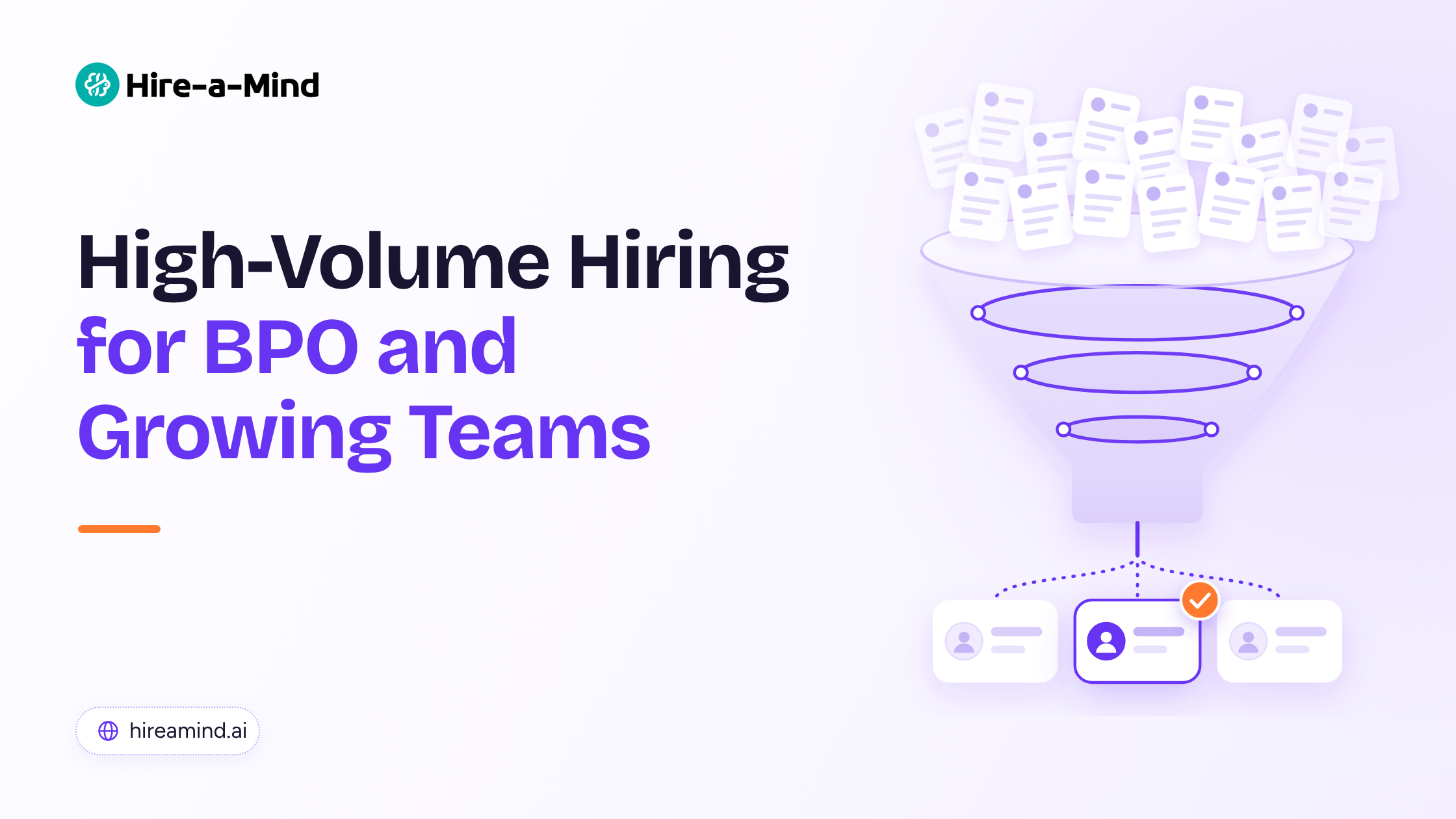
High-Volume Hiring for BPO and Growing Teams: What AI Should Actually Do
Learn how AI helps BPO and growing teams handle high applicant volume, from CV screening and interviews to evidence-backed decisions made by people.
AI Hiring10 min read
On this page
- What is AI for high-volume hiring?
- Why is high-volume hiring so hard for BPO and growing teams?
- What should AI actually do for high-volume hiring?
- What does this look like in practice?
- What does a good high-volume hiring workflow look like?
- How does Hire-a-Mind bring this together?
- What should good AI hiring ultimately deliver?
- Frequently asked questions
BPO and growing teams often face the same problem: far more applicants than recruiters can read, interview and compare consistently, usually at short notice. AI should help teams absorb that volume, apply the same criteria to every candidate and surface the evidence, while recruiters keep making every hiring decision.
Good AI hiring should increase recruiter leverage and consistency, not remove human judgment.
What is AI for high-volume hiring?
AI for high-volume hiring is the use of AI to screen, interview and evaluate large numbers of applicants against the same role criteria, so recruiters can review the evidence and make the decisions.
It covers the stages where volume is highest and the work is most repetitive, from the first CV through interviews to the evaluation behind the decision. The goal is not a faster pile of CVs. It is a shorter, better-evidenced list of people worth a recruiter's time, with a reason behind each name.
Why is high-volume hiring so hard for BPO and growing teams?
A single customer support role can attract more applications than a team can read carefully, and a new client program may need dozens of hires in a short window. A growing company faces a quieter version: several roles open at once, a small recruiting team and more interviewers every month. In both cases, the challenge is less finding people than reviewing them consistently and quickly.
- Very high applicant volume: a thousand applications for one opening can become a recruiter's full-time problem.
- Frequent and seasonal ramp hiring: demand arrives in waves, and the team has to scale up and back down.
- High attrition: steady backfill means the same roles are screened again and again.
- Communication, language and voice skills: for many roles, how a candidate speaks and writes is part of the job.
- Shift availability: a strong candidate who cannot work the required shifts is still a mismatch.
- Speed to hire: a slow process delays the ramp, and good candidates may accept other offers.
- Consistency across many recruiters: different people screen differently, and standards drift between waves.
Growing teams add one more pressure. More interviewers can mean more opinions and less consistency, because each person asks different questions and weighs different things.
So the question is not simply how to screen faster. It is how to handle much higher volume without lowering the quality of review or adding headcount at the same rate. If a team suddenly has dozens of agents to hire next month, how can it give every applicant a consistent, evidence-based review without adding the same number of recruiters and interviewers?
What should AI actually do for high-volume hiring?
Eight capabilities describe the model, independent of any product.
1. Process Every Application, Not Just the First Few
When volume spikes, manual screening degrades: recruiters skim, later applications get less attention and strong candidates can be missed simply because they arrived on day six. AI can process every CV against the same criteria, rank applicants, show the reason behind each score and keep working through a spike, so ramp and seasonal hiring does not build a backlog. AI should widen the number of people who get a consistent review, not narrow it.
2. Screen Against the Role's Actual Criteria
Generic keyword matching works poorly at volume. AI should understand what this role needs: the must-haves, the preferred skills, the weight of each criterion and the gaps worth flagging. AI should score each CV against those criteria, show the supporting lines, and send uncertain or low-scoring cases to a person rather than discarding them. The AI should evaluate against the role, not against a generic idea of a good candidate.
3. Run Structured First-Round Interviews at Scale
Most first-round screens ask the same questions: experience, motivation, availability, expectations and a few role-specific scenarios. At volume, recruiters can spend weeks repeating them. AI can run these as structured first-round interviews. Candidates take them on their own time, which helps when applicants work shifts, everyone gets the same questions, and answers are transcribed and scored against the role's criteria. The hiring team can include questions on availability and shifts. AI first-round interviews should remove repetitive screening calls, not human interviews.
4. Assess Communication and Language Skills Consistently
For BPO roles in particular, communication is part of the work, and it is hard to judge consistently across many recruiters. A structured text or voice interview gives every candidate the same prompts and a transcript, so the team compares like with like instead of impressions from different phone calls. AI should score what candidates said against the criteria for the role, with the evidence linked, and it should not guess at things it cannot judge fairly, such as accent or background. Language requirements differ by program, so the team sets the bar, and people judge the final fit, usually in a human interview.
5. Support Technical Roles Without Stretching Interviewers
Growing teams often hire engineers, analysts or other specialists, and every early technical conversation pulls a busy senior person away from their work. AI can run structured technical first-round interviews, because the interviewer or hiring team sets the questions and the assessment criteria. This widens early technical screening capacity without a specialist in every first conversation. AI does not replace expert interviewers: they stay responsible for deeper validation and final judgment.
6. Keep Every Recruiter and Interviewer on the Same Standard
Consistency is one of the first things to break when volume rises. One recruiter weighs experience, another weighs communication, a third relies on gut feel, and the standard drifts between waves. A good AI workflow sets the criteria once and applies them everywhere: CV screening, AI interviews and human interviews all score against the same bar, and reviewers score independently so one opinion does not anchor the next. That makes decisions easier to compare and defend, whether a few people interview or dozens. An illustrative example:
- Role criteria: clear written communication; weekday evening availability; customer service experience.
- CV evidence: two years in a customer support role.
- AI interview evidence: answers a refund-request scenario clearly and calmly.
- Recruiter decision: progress to a human interview; probe handling of difficult callers.
7. Connect AI and Human Interviews
A candidate may move from CV to AI interview to a recruiter call to a hiring manager interview, and these stages often become disconnected, so the manager repeats questions or starts from a blank scorecard. A good AI workflow carries the evidence forward, so the criteria, CV evidence, AI interview scores and human interview results end up in one evaluation. The value of AI increases when every stage adds evidence to the same candidate evaluation rather than creating another isolated scorecard.
8. Keep Humans in Control
AI should: read, structure, summarize, score, surface evidence, flag gaps and recommend.
People should: review, challenge, interview, validate, make the decision, speak with candidates and make the offer.
AI should not:
- reject candidates automatically without human oversight
- make final hiring decisions
- hide why a candidate received a score
- judge accent, background or other traits it cannot assess fairly
- apply the same generic criteria to every role
- turn interviews into black-box scores
Consistent criteria and visible evidence make decisions easier to review, but they do not guarantee fairness on their own: people still need to review and challenge the results. The AI recommends. People decide. Good AI hiring makes the recruiter more informed, not less accountable.
What does this look like in practice?
Take an illustrative scenario: a BPO is ramping up 40 customer support agents for a new client program. For the opening, the team might receive 1,000 applications. These numbers are illustrative, not a benchmark.
Illustrative funnel for one hiring wave (not a benchmark)
- Applications received: 1,000
- After AI screening and recruiter review: 300 reasonable matches
- After AI first-round interviews: 120 recommended for review
- After human interviews: 80 finalists
- Outcome: 40 hires
How the same work changes with and without AI
- Reviewing applications
- Without AI: Recruiters skim, and later applications get less attention
- With AI-assisted hiring: Every application is processed against the same criteria and ranked with reasons
- First-round interviews
- Without AI: Recruiters repeat the same screening calls
- With AI-assisted hiring: Candidates interview on their own time with the same questions
- Communication and language
- Without AI: Judged differently by each recruiter
- With AI-assisted hiring: Same prompts, with transcripts and scores linked to what was said; people judge the final fit
- Consistency
- Without AI: Standards drift between recruiters and waves
- With AI-assisted hiring: One set of criteria and evidence across stages
- Speed to decision
- Without AI: Backlog builds while recruiters work through the queue
- With AI-assisted hiring: Recruiters start from a ranked, evidence-backed shortlist
- Hiring decision
- Without AI: Evidence scattered across CVs, interview notes and spreadsheets
- With AI-assisted hiring: Evidence accumulated across screening and interviews in one evaluation
The difference is not that people disappear. It is where their time goes. Without AI, a larger wave means proportionally more screening hours, and eventually more recruiters. With AI, recruiters spend that time reviewing shortlists, holding human interviews, challenging scores and making decisions. That is recruiter leverage; no productivity statistic is claimed.
What does a good high-volume hiring workflow look like?
A good workflow follows the order in which evidence builds up, with a person in control at each stage:
- Define the role once. Write the job description, the must-haves and the weighted criteria before the first application arrives.
- Collect applicants. Gather CVs through an application link or by upload, so volume lands in one place.
- Screen and rank with evidence. AI scores every CV against the criteria and shows the reasons; low scores go to a person.
- Run first-round interviews. Shortlisted candidates take the same structured interview, by text or voice, on their own time.
- Review. Recruiters read the ranked shortlist, the scores and the evidence, and challenge anything that looks wrong.
- Hold human interviews. Hiring managers and panels interview the strongest candidates against the same criteria.
- Evaluate and decide. The evidence from every stage comes together, and people make the final decision and the offer.
How does Hire-a-Mind bring this together?
This is the model Hire-a-Mind is built around: not simply automating one hiring task, but connecting the evidence across the hiring workflow.
The core idea is simple: the criteria used to define a role should remain connected to the evidence collected throughout the hiring process. A role is defined once. Those weighted criteria then drive CV screening, AI Interviews, human interviews, a cumulative evaluation and the final decision. The result is one hiring standard, evidence across every stage and one decision record.
The flow is role criteria → CV evidence → AI Interview evidence → human interview evidence → cumulative evaluation → final decision.
Take a BPO running two client programs (an illustrative example). Program A needs English communication, evening-shift availability and customer support experience. Program B needs technical troubleshooting, night-shift availability and specific product knowledge. Each program is one role with one set of criteria: Beacon holds each program's weighted criteria, and Sift, Scout and the human interviews score every candidate against them, so the evidence stays tied to the right standard from first CV to final decision.
- Beacon: defines the role, ideal candidate profile and weighted criteria, from capability and communication to behavioral and potential and fit. Beacon is free forever.
- Sift: processes every CV, collected through an application link or upload, against those criteria, ranks the results and shows the CV lines behind each score. AI never rejects a candidate.
- Scout: runs structured text or voice AI Interviews against the same criteria, with each score linked to the transcript. Voice interviews currently run in English.
- Human interviews on Google Meet: continue the evaluation using the same criteria, with the transcript assessed against them.
- Evaluation: combines stage scores, cited evidence, reviewer notes and finalist comparison into one decision record.
The AI recommends. People decide. Your team makes the hiring decision. Hire-a-Mind publishes volume-based pricing, with Free, Starter, Growth and Enterprise plans. See pricing
What should good AI hiring ultimately deliver?
The end goal is not "we used AI." It is: we can give every applicant a consistent, evidence-based review, and give our hiring managers a stronger shortlist, faster, with evidence behind every recommendation.
For a BPO or a growing team, AI hiring is not about replacing recruiters. It is about giving them capacity for far higher volume while keeping decisions consistent, explainable and in human hands.
To go deeper, read What Is an AI-Powered Hiring Platform?, Hiring Intelligence: How a Connected Hiring Workflow Works and The End of Gut-Feeling Hiring, or see how AI Interviews work.
Hiring in volume? Start with one role.
Screen every application against the same criteria, run first-round interviews, continue with human interviews, and see the evidence behind each shortlist before you decide.
The AI recommends. People decide.
Frequently asked questions
What is AI for high-volume hiring?
- It is the use of AI to screen, interview and evaluate large numbers of applicants against the same role criteria, so recruiters can review the evidence and make the decisions. For BPO and growing teams, it handles the repetitive stages and gives recruiters a ranked, explained shortlist instead of a pile of CVs.
How can AI help BPO teams handle high applicant volume?
- AI can process every CV against the same weighted criteria, rank applicants with the reasons shown, and run structured first-round interviews on candidates' own schedules. That lets a team process far more applicants during a ramp or seasonal wave while recruiters focus on reviewing the shortlist, interviewing and deciding.
Can AI screen every CV consistently?
- Yes. AI can check each CV against the same criteria and show the evidence behind each score, so every applicant gets the same review. That improves consistency, but it does not guarantee fairness on its own: people should review the results, challenge them and make the decision. In Hire-a-Mind, Sift screens every CV this way.
Does AI reject candidates automatically?
- It should not. Good screening ranks applicants and explains each score, and low scores should route to a person who decides. In Hire-a-Mind, AI never rejects a candidate: a low score sends the CV to a person, and only your team can reject. The AI recommends, and people decide.
Can AI run first-round interviews at scale?
- Yes. AI can run structured first-round interviews with the same questions for every candidate, taken on the candidate's schedule, with answers transcribed and scored against the role's criteria. It should remove repetitive screening calls, not human interviews. In Hire-a-Mind, Scout runs these by text or voice, and the hiring team chooses the questions.
Can AI assess communication and language skills?
- AI can run text or voice interviews with the same prompts for every candidate and score what they said against the role's communication criteria, with the transcript as evidence. It should not judge accent or background. People decide whether the language level fits the role, and in Hire-a-Mind voice interviews currently run in English.
Can AI conduct technical interviews?
- Yes. Scout, Hire-a-Mind's AI interviewer, can conduct technical interviews because the interviewer or hiring team sets the questions and assessment criteria. Each answer is scored against those criteria. People review the results and make the decision; AI does not replace expert interviewers or final judgment on complex roles.
How can growing teams keep hiring consistent as more people interview?
- Define the criteria once and score every stage against them, so recruiters, AI interviews and hiring managers use the same bar. Let reviewers score independently before comparing, keep the evidence for each score and record the decision in one place.
Does AI replace recruiters in high-volume hiring?
- No. AI processes, structures, scores and surfaces evidence. Recruiters review, challenge, interview, decide and make the offer. AI handles the repetitive early stages, while relationships, judgment and accountability stay with people. The goal is recruiter leverage: far more applicants handled with consistent evidence, and people accountable for every decision.
What should a team look for in AI hiring software?
- Criteria set per role, scores that show their evidence, no automatic rejection, structured interviews that connect to human interviews, one cumulative evaluation across stages and a clear decision record. Also check that the language options fit your roles and how pricing scales with the hiring volume you actually run.
- High-Volume Hiring
- BPO Hiring
- AI Hiring
- Hire-a-Mind
- AI Candidate Screening
- AI Interviews
- Candidate Evaluation
- Hiring Intelligence
Keep reading
All articles
AI Hiring
AI Hiring for Recruitment & Staffing Agencies: What It Should Actually Do
Learn how AI hiring helps recruitment and staffing agencies handle more roles, screen CVs, run interviews and make evidence-backed client recommendations.
Interview Intelligence
Best Interview Note-Taker Tools vs Hire-a-Mind: Notes or a Connected Hiring Workflow?
Interview note-taker tools in 2027 compared: Metaview, BrightHire, Fireflies, Otter, Fathom and more, vs Hire-a-Mind's connected hiring workflow.
AI Hiring
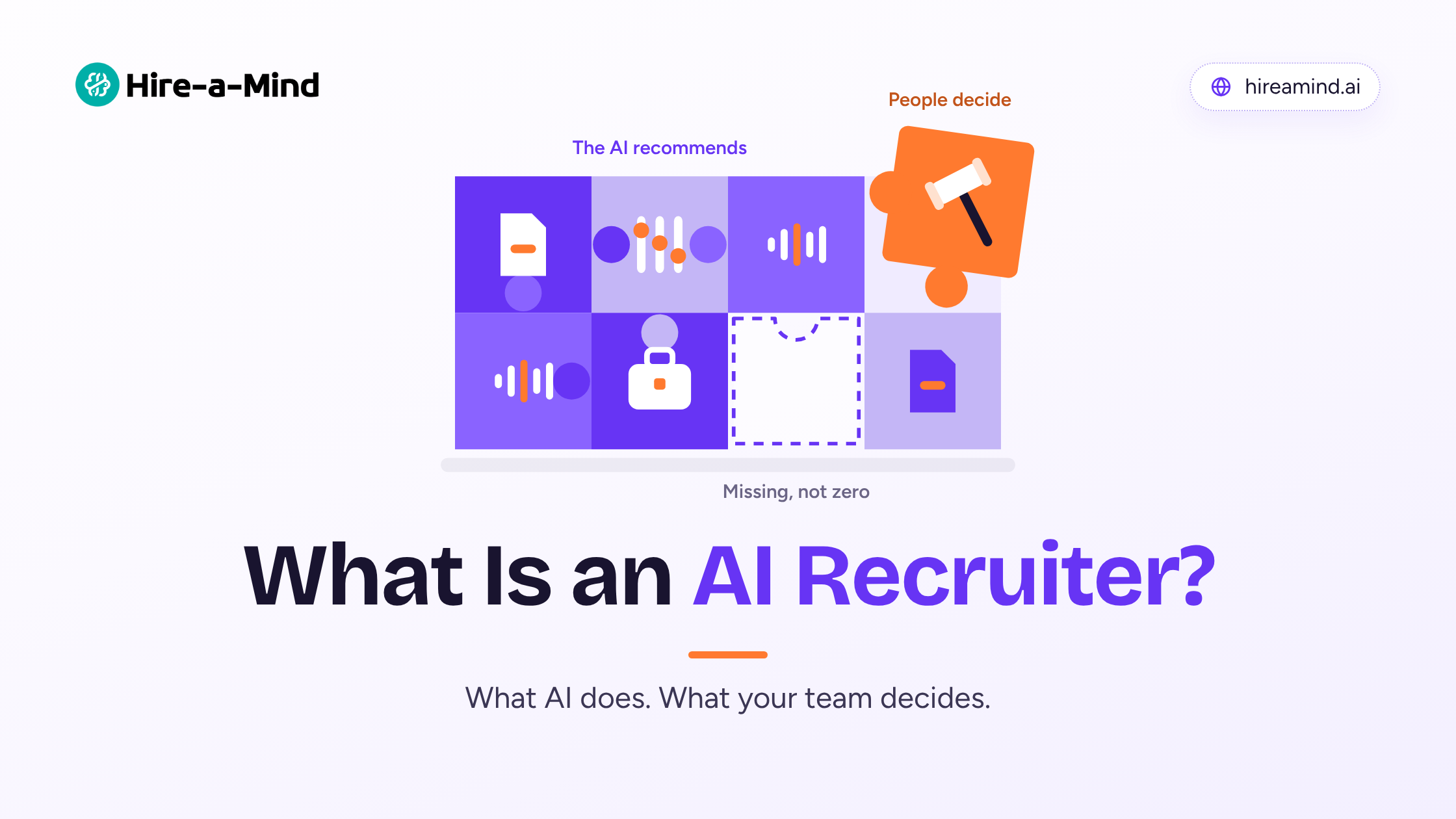
What Is an AI Recruiter? What AI Recruiting Agents Can Do and What Your Team Still Decides
An AI recruiter screens CVs, runs structured interviews and surfaces evidence. Learn what AI recruiting agents should do and what your team still decides.