
What Is an AI Recruiter? What AI Recruiting Agents Can Do and What Your Team Still Decides
An AI recruiter screens CVs, runs structured interviews and surfaces evidence. Learn what AI recruiting agents should do and what your team still decides.
AI Hiring10 min read
On this page
- What is an AI recruiter?
- Why are teams looking at AI recruiting agents now?
- What should an AI recruiter actually do?
- What should your team still decide?
- What is the real test of an AI recruiter?
- Can AI recruiting agents support our hiring goals?
- Are AI recruiting agents effective for niche roles?
- How is an AI recruiter different from a recruitment agency or an ATS?
- What does an AI recruiter look like in practice?
- What does a good AI recruiting workflow look like?
- How does Hire-a-Mind approach the AI recruiter?
- What should a good AI recruiter ultimately deliver?
- Frequently asked questions
An AI recruiter is software that takes on repetitive recruiting work: it turns a role into criteria, processes CVs against them, runs structured first-round interviews and summarizes the evidence. It should give your team a ranked, explained shortlist. It should not decide who gets hired.
A good AI recruiter is not the one that automates the most. It is the one that leaves the clearest evidence behind every recommendation.
What is an AI recruiter?
An AI recruiter, sometimes called an AI recruiting agent or AI hiring agent, is software that uses artificial intelligence to carry out defined recruiting tasks, such as screening CVs, interviewing candidates and scoring answers against a role's criteria, and then hands the results to people who make the decision.
The term can cover a broad range of recruiting tasks, from sourcing and candidate communication to screening and interviewing. "Artificial intelligence recruiters" and "AI recruiting agents" usually describe the same idea, while "AI headhunter" often points at sourcing: finding people who have not applied yet. In this article, the focus is on the evaluation side of recruiting: what happens once candidates are in your pipeline, which parts of that work an AI recruiter should take on, and which must stay with your team.
Why are teams looking at AI recruiting agents now?
Recruiting is rarely hard because each step is complex. It is hard because the same steps repeat for every candidate and role, and volume rarely matches the size of the team.
- CV volume outgrows attention: later CVs get skimmed and good candidates are missed.
- First-round calls repeat: the same opening questions, again and again.
- Interviewers are scarce: specialists are pulled into early conversations that could be structured.
- Standards drift: different recruiters and interviewers weigh different things.
- Evidence scatters: CV notes, interview impressions and scorecards end up in different places.
An AI recruiter promises capacity. The risk is capacity without accountability: faster decisions nobody can explain. Good AI recruiting should increase recruiter leverage, not remove recruiter judgment.
What should an AI recruiter actually do?
Seven capabilities describe a useful AI recruiter, independent of any product.
1. Turn the Role Into Clear Criteria First
An AI recruiter is only as good as the standard it is given. Before the first CV arrives, the role should be written down as must-haves, preferred skills and weighted criteria that every later step scores against. If the criteria are vague, automation simply produces vague results faster.
2. Process Every CV Against the Same Criteria
AI can process every CV against the role's criteria, rank applicants and show the lines behind each score, so every applicant gets a consistent review, not just the first few. Low or uncertain scores should go to a person, not into a silent rejection pile. The AI should evaluate against the role, not against a generic idea of a good candidate.
3. Run Structured First-Round Interviews
Most first-round screens cover the same ground: experience, motivation, availability and role-specific questions. An AI recruiter can run these as structured interviews candidates take on their own schedule. Everyone gets the same questions, and each transcribed answer is scored against the role's criteria. AI first-round interviews can take on repetitive screening calls, while human interviews remain focused on deeper evaluation.
4. Support Technical and Specialist Interviews
An AI recruiter can run technical first-round interviews when the interviewer or hiring team sets the questions and assessment criteria. The AI asks, records and scores against that standard; it does not invent what good looks like. That widens early technical screening while experts stay responsible for deeper validation.
5. Show the Evidence Behind Every Score
A score without a reason is just another opinion. Each CV score should point to the lines in the CV, and each interview score to the moment in the transcript, so recruiters and hiring managers can check the AI's reasoning instead of trusting it.
6. Connect AI and Human Interviews
When CV screening, first-round interviews and human interviews are disconnected, interviewers repeat questions and start from blank scorecards. A good AI recruiter carries the evidence forward, so human interviewers assess against the same criteria. The value of AI increases when every stage adds evidence to the same candidate evaluation rather than creating another isolated scorecard.
7. Hand the Decision Back to People
The last job of an AI recruiter is to stop: present a ranked, explained shortlist and a cumulative evaluation, then step aside while your team decides.
The common thread across all seven capabilities is simple: every automated step should leave evidence that a human can explain.
What should your team still decide?
AI should: process, structure, summarize, score, surface evidence, flag gaps and recommend.
People should: set the criteria, review, challenge, interview, validate, make the decision, speak with candidates and make the offer.
An AI recruiter should not:
- reject candidates automatically without human review
- make final hiring decisions
- hide why a candidate received a score
- invent criteria the hiring team did not set
- judge traits it cannot assess reliably, such as accent or background
- turn interviews into black-box scores
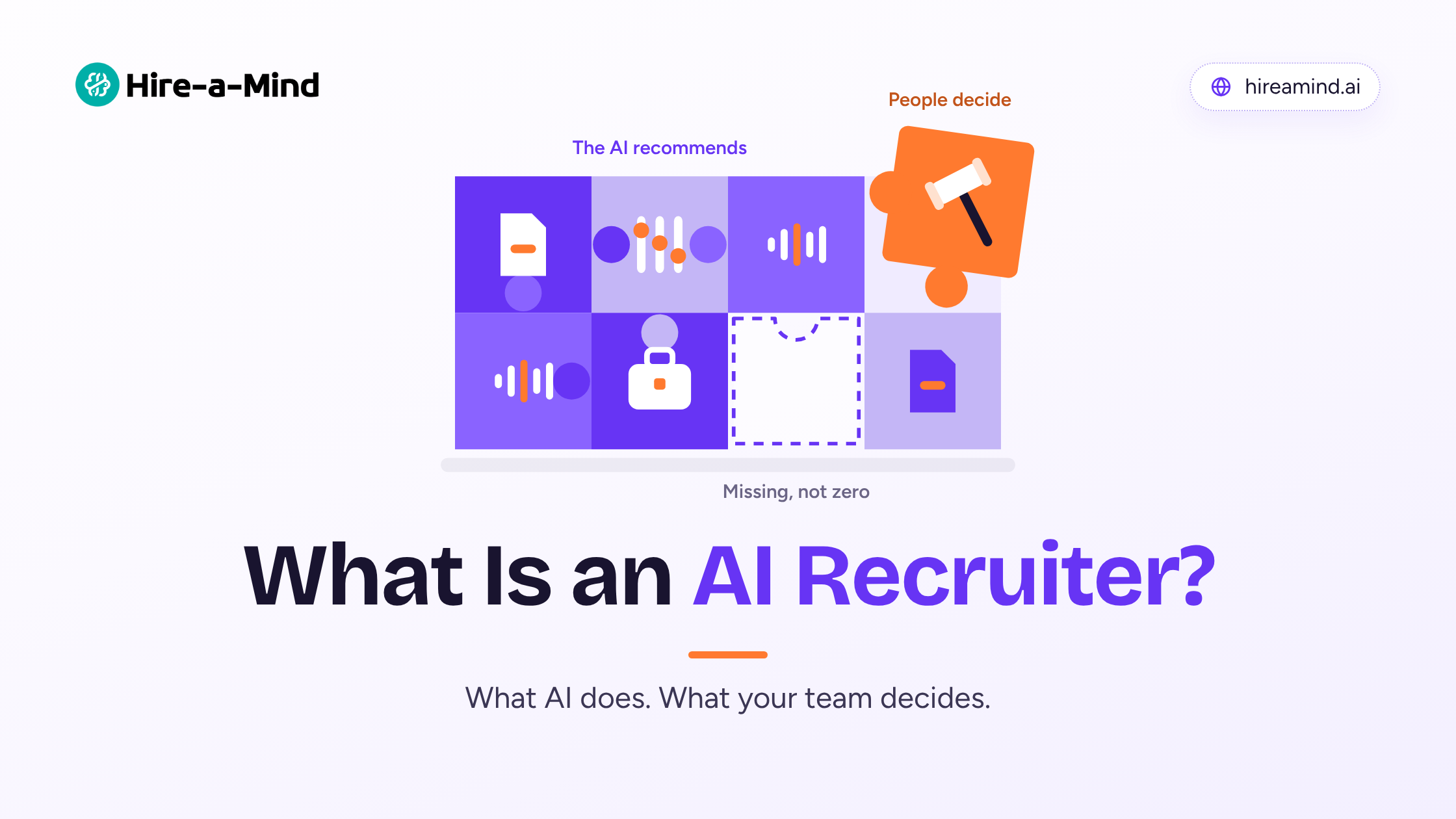
Consistent criteria and visible evidence make decisions easier to review, but they do not guarantee fairness on their own; people still need to challenge the results. The AI recommends. People decide.
What is the real test of an AI recruiter?
Most articles measure AI recruiters by what they automate. A better measure is what they leave behind. Call it the explain-back test: for any candidate, can someone on your team explain why that person was advanced or held back, using only the evidence the AI recorded?
To pass, it must keep four things together for every candidate:
- the criterion that was being assessed
- the evidence behind the score, such as a CV line or a transcript moment
- who scored it, AI or a named person
- what is still missing, shown as missing rather than as a low score
If the explanation needs a recruiter's memory, a separate spreadsheet or "the AI said so," the tool has added speed but not judgment. If it is right there, the AI recruiter has done its real job: making the people who decide better informed.
Can AI recruiting agents support our hiring goals?
Yes, if the goal is capacity and consistency, and the agent works inside a process your team controls. It can help you review more applicants against the same criteria, cut repetitive screening calls and give hiring managers a shortlist with evidence instead of a pile of CVs.
It will not fix an unclear role, replace candidate relationships or make a hard decision for you. Name the goal first, whether consistent screening, faster first rounds or better-documented decisions, then check whether the AI recruiter supports it.
Are AI recruiting agents effective for niche roles?
They can be, on one condition: the hiring team, not the AI, defines what good looks like. Niche roles have narrow criteria, where a generic idea of a strong candidate fails.
When the hiring team sets the questions and criteria, an AI recruiter can run a consistent technical first round and score each answer against that standard, with the transcript as evidence. Experts then focus on candidates who already showed relevant depth. For niche roles, the AI widens the first round; the specialists still make the call.
How is an AI recruiter different from a recruitment agency or an ATS?
People searching for an "AI recruiting agency" often ask whether an AI recruiter replaces an agency, an applicant tracking system or both. They do different jobs.
AI recruiter vs recruitment agency vs ATS: what each one does
- Main job
- Applicant tracking system (ATS): Stores applicants, stages and records
- Recruitment agency: Finds and presents candidates for a fee
- AI recruiter (done well): Processes, interviews and scores candidates against your criteria
- Who defines the bar
- Applicant tracking system (ATS): Your team, outside the system
- Recruitment agency: The agency, from your brief
- AI recruiter (done well): Your team, in weighted criteria every stage uses
- Screening
- Applicant tracking system (ATS): Usually filters and keyword search
- Recruitment agency: Recruiter judgment
- AI recruiter (done well): Every CV processed against the same criteria, with reasons
- First-round interviews
- Applicant tracking system (ATS): Usually scheduling, not the interview itself
- Recruitment agency: Recruiter phone screens
- AI recruiter (done well): Structured interviews on the candidate's schedule, scored with transcripts
- Who decides
- Applicant tracking system (ATS): Your team
- Recruitment agency: Your team, on the agency's recommendation
- AI recruiter (done well): Your team, on an evidence-backed shortlist
- Hiring decision evidence
- Applicant tracking system (ATS): Records and notes stored per stage
- Recruitment agency: A CV and a recruiter summary
- AI recruiter (done well): Evidence accumulated across screening and interviews in one evaluation
An AI recruiter does not replace an agency's relationships or its reach into passive candidates, and agencies use AI too (see AI hiring for recruitment and staffing agencies). Its core job is also different from an ATS: it turns applicants into explained, comparable evidence.
What does an AI recruiter look like in practice?
Take an illustrative example: a software company hiring a backend engineer, with three weighted criteria set by the hiring manager: distributed systems experience, on-call ownership and clear communication. Here is what one candidate's evidence trail might look like; the details are invented for illustration.
Illustrative evidence trail for one candidate
- Role criteria: Three criteria, each weighted by the hiring manager
- CV screening: Match score with the CV lines behind it, such as running an on-call rota for a payments API
- AI first-round interview: Technical questions set by the hiring team; each answer scored and linked to the transcript
- Recruiter review: Recruiter checks the scores and flags communication to probe further
- Human interview: Panel assessed against the same criteria; reviewers score independently
- Decision: Hiring manager compares finalists and records the decision and the reason
The AI recruiter did the repetitive work; people made each judgment. Without it, the decision would rest on a CV, a few call notes and a memory of the panel. With it, anyone can see why this candidate moved forward.
What does a good AI recruiting workflow look like?
A good workflow follows the order in which evidence builds up, with a person in control at each stage:
- Define the role once: job description, must-haves and weighted criteria, before the first CV.
- Collect applicants in one place: through an application link or by upload.
- Screen and rank with evidence: every CV scored against the criteria, with reasons; low scores go to a person.
- Run structured first-round interviews: the same questions, by text or voice, on the candidate's time.
- Review: recruiters check the shortlist and evidence, and challenge what looks wrong.
- Hold human interviews: panels assess the strongest candidates against the same criteria.
- Evaluate and decide: evidence from every stage comes together, and people make the decision and the offer.
How does Hire-a-Mind approach the AI recruiter?
This is the model Hire-a-Mind is built around: not simply automating one recruiting task, but connecting the evidence across the hiring workflow.
The criteria used to define a role should remain connected to the evidence collected throughout the hiring process. The flow is role criteria → CV evidence → AI Interview evidence → human interview evidence → cumulative evaluation → final decision.
- Beacon: defines the role, the ideal candidate profile and the weighted criteria that every later stage scores against.
- Sift: processes every CV, collected through an application link or upload, against those criteria, ranks the results and shows the CV lines behind each score. AI never rejects a candidate; a low score sends the CV to a person.
- Scout: runs structured text or voice AI Interviews on the candidate's schedule. The hiring team sets the questions and criteria, which is why Scout can run technical interviews, and each score is linked to the transcript.
- Human interviews on Google Meet: continue the evaluation against the same criteria, with the transcript assessed against them.
- Evaluation: brings stage scores, cited evidence and reviewer notes into side-by-side finalist comparison and one decision record. Missing scores show as missing, never as zero.
The AI recommends. People decide. Your team makes the hiring decision. Hire-a-Mind publishes volume-based pricing, with Free, Starter, Growth and Enterprise plans. See pricing
What should a good AI recruiter ultimately deliver?
The end goal is not "we used an AI recruiter." It is: we can give every applicant a consistent, evidence-based review, and give hiring managers a stronger shortlist, faster, with the evidence behind every recommendation.
An AI recruiter earns its place when it makes your team more capable and more accountable at the same time.
To go deeper, see how high-volume hiring works for BPO and growing teams and why human-first AI recruitment keeps people at the center.
Thinking about an AI recruiter? Start with one role.
Define the role once, screen every CV against the same criteria, run structured first-round interviews, continue with human interviews, and see the evidence behind every recommendation before you decide.
The AI recommends. People decide.
Frequently asked questions
What is an AI recruiter?
- An AI recruiter is software that uses artificial intelligence to handle defined recruiting tasks: turning a role into criteria, processing CVs against them, running structured first-round interviews and scoring answers with evidence. It hands a ranked, explained shortlist to people, who review the evidence and make every hiring decision.
Can AI recruiting agents support our hiring goals?
- Yes, if your goals are capacity and consistency. An AI recruiting agent can process more applicants against the same criteria, reduce repetitive screening calls and give hiring managers an evidence-backed shortlist. It will not fix an unclear role or make the decision, so name the goal first and check the evidence.
Are AI recruiting agents effective for niche roles?
- They can be, when the hiring team defines the questions and assessment criteria. The AI then runs a consistent first round, scores each answer against that standard and links it to the transcript. Specialists spend their time on candidates who already showed relevant depth, and they validate details and decide in human interviews.
Is an AI recruiter the same as an AI headhunter?
- Not always. "AI headhunter" often refers to sourcing: finding people who have not applied. An AI recruiter, in the sense used here, evaluates the candidates already in your pipeline, screening CVs, running structured interviews and scoring them against your criteria. Many teams need evaluation help more than more candidates.
Can an AI recruiter conduct technical interviews?
- Yes, when the interviewer or hiring team sets the questions and criteria. In Hire-a-Mind, Scout can run technical interviews on that basis, and each score is linked to the transcript. AI widens early technical screening capacity; expert interviewers still validate depth in human interviews and make the final judgment.
Does an AI recruiter reject candidates automatically?
- It should not. A good AI recruiter ranks candidates and explains each score, and low scores go to a person who decides. In Hire-a-Mind, AI never rejects a candidate: a low score sends the CV to a person, only your team can reject, and rejections are sent by a person.
Will AI recruiters replace human recruiters?
- No. AI recruiters take on the repetitive stages: processing CVs, structuring first-round interviews, scoring and summarizing evidence. Recruiters set the criteria, review and challenge the results, interview, decide and build relationships with candidates. The goal is recruiter leverage, with people accountable for every hiring decision.
What is the difference between an AI recruiter and a recruitment agency?
- A recruitment agency finds and presents candidates using its network and judgment, usually for a fee. An AI recruiter processes, interviews and scores candidates against criteria your team sets, and keeps the evidence. They solve different problems, and many agencies use AI recruiting to support their own work.
Is an AI recruiting agent worth it for a small hiring team?
- It can be, when a small team faces more applicants or interviews than it can review consistently. Look for criteria set per role, evidence behind every score, no automatic rejection and pricing that scales with how much you hire. Starting with one role shows quickly whether it saves time.
How should we evaluate an AI recruiting tool?
- Apply the explain-back test: for any candidate, can your team explain the outcome from the evidence the tool recorded? Also check that criteria are set per role, scores link to CV lines or transcripts, AI never rejects on its own, and AI and human interviews feed one evaluation.
- AI Recruiter
- AI Recruiting Agents
- AI Hiring
- AI Interviews
- Hire-a-Mind
- AI Headhunter
- Hiring Intelligence
- Recruitment Automation
- Candidate Evaluation
Keep reading
All articles
AI Hiring
AI Hiring for Recruitment & Staffing Agencies: What It Should Actually Do
Learn how AI hiring helps recruitment and staffing agencies handle more roles, screen CVs, run interviews and make evidence-backed client recommendations.
AI Hiring
High-Volume Hiring for BPO and Growing Teams: What AI Should Actually Do
Learn how AI helps BPO and growing teams handle high applicant volume, from CV screening and interviews to evidence-backed decisions made by people.
AI Hiring
Metaview Alternatives in 2027: From Interview Intelligence to Full Hiring Workflows
Looking for Metaview alternatives? Compare BrightHire, Hire-a-Mind, Manatal, HireVue and meeting-intelligence tools by workflow, AI interviews, evaluation.