
Accent Bias in Interviews: Judging the Answer, Not the Accent
Accent bias can lower interview scores even for identical answers. See what research shows and how to assess communication without judging the accent.
AI Hiring11 min read
On this page
- What is accent bias in interviews?
- What does research say about accents and hiring?
- Where does accent bias show up in hiring?
- When is communication genuinely job-relevant?
- What gets judged, and what should be judged?
- How can hiring teams judge the answer, not the accent?
- Can AI interviews reduce accent bias, or add new problems?
- Where does Hire-a-Mind fit?
- What is the takeaway for hiring teams?
- Frequently asked questions
Imagine two candidates who give essentially the same answer. One may have an accent the interviewer knows well, and the other may not. If the first is described as "confident" and the second as "hard to follow", the difference may not be in the answer at all.
Accent bias in interviews happens when the way a candidate sounds affects how their answer is judged, rather than what they actually say. Research links non-standard accents to lower hireability ratings, even when the answers are identical. The practical response is to define the communication a job needs, then score the substance of each answer against it.
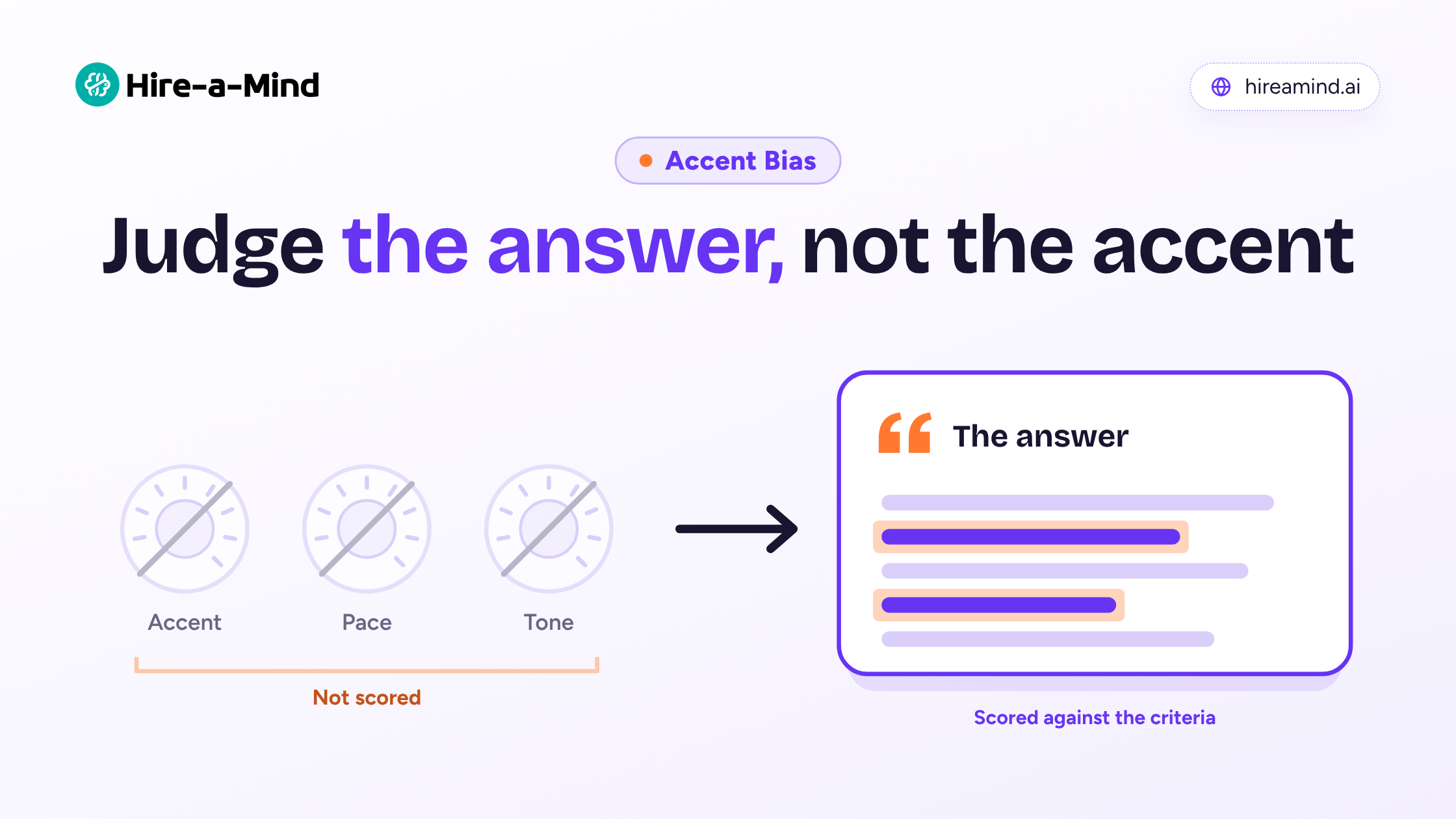
Judge the answer, not the accent. If a role needs clear communication, define what that means and assess it directly, so the way someone sounds does not stand in for it.
This article is practical guidance for hiring teams. It is not legal advice. Rules on discrimination differ by country, so speak with employment counsel about your own situation.
What is accent bias in interviews?
Accent bias is the tendency to judge a person's ability, intelligence or suitability by how they sound rather than by the content of what they say.
Everyone has an accent. Accent bias is not about accents themselves but about the assumptions listeners attach to them. It affects people who learned English as an additional language, and it also affects native speakers with regional, working-class or minority-dialect accents. The Sutton Trust's 2022 report Speaking Up: Accents and Social Mobility describes accent as arguably the primary signal of socio-economic status, and a major indicator of other parts of a person's background, including some protected characteristics such as race.
A related idea is "native-speakerism". The applied linguist Adrian Holliday described it in 2006, in the context of English language teaching, as an ideology that treats the "native speaker" as the ideal and others as less capable. He also noted that the labels "native" and "non-native" speaker are contested. This article uses them sparingly, mostly where a study does, because the line between the two is less clear than it sounds.
Is accent protected under UK law?
In the UK, accent is not itself listed as a protected characteristic. But under section 9 of the Equality Act 2010, race includes colour, nationality and ethnic or national origins. In Carozzi v University of Hertfordshire (2024), the Employment Appeal Tribunal said an accent may be an important part of a person's national or ethnic identity, and that comments about it could be related to race. It also made clear that not every mention of an accent amounts to harassment. Other countries have their own rules.
What does research say about accents and hiring?
Most studies point in the same direction, though the size of the effect depends on the setting, and not every study finds an overall effect.
- A meta-analysis across many studies. Spence, Hornsey, Stephenson and Imuta (Personality and Social Psychology Bulletin, 2024) combined 139 effect sizes from 4,576 participants. Candidates with standard accents were rated as more hireable than candidates with non-standard accents, and the bias was stronger for jobs with high communication demands. Two further findings matter for hiring teams. How easy a candidate was to understand did not significantly predict the bias, while perceptions of the candidate's social status did. The bias was also more pronounced for female candidates and for foreign rather than regional accents.
- The same words, a different verdict. In a study by Huang, Frideger and Pearce (Journal of Applied Psychology, 2013), candidates with non-native accents gave the same scripted answers as native speakers, yet were less likely to be recommended for a middle-management role. The gap was explained by lower ratings of their perceived "political skill", not by ratings of their communication skill.
- Regional accents among native speakers. Levon and colleagues (Journal of English Linguistics, 2021) asked 848 adults in England to rate mock interview answers for a trainee solicitor role. Overall, accent had no significant main effect. But older listeners, those over 45, rated candidates with Southern working-class accents lower than candidates with other accents. Answers showing technical expertise reduced the effect without fully removing it.
- Lived experience at work. In the Sutton Trust survey, 25% of professionals said they had been mocked, criticised or singled out for their accent at work. Among senior managers, 29% from working-class families said they had been mocked at work for their accent, compared with 22% from better-off backgrounds.
Together, these findings suggest that accent bias is often less about being understood and more about status and assumptions. That makes it hard to spot, because it tends to show up as a judgement about something else: "confidence", "polish", "presence" or "communication".
Where does accent bias show up in hiring?
Accent bias can enter at any stage where people listen to candidates speak, and also where their words pass through technology.
- Phone screen
- How accent bias can show up: A quick "not a strong communicator" note after a short call
- A structured check: Ask the same screening questions and score the answers, not the impression
- Live interview
- How accent bias can show up: The interviewer listens less closely, interrupts or rushes the candidate
- A structured check: Allow natural pauses, ask for repetition when needed and take notes on content
- Panel interview
- How accent bias can show up: One panel member's reaction to an accent shapes everyone's view
- A structured check: Have each panel member score independently before discussion
- Debrief
- How accent bias can show up: Vague words such as "polish", "presence" or "fit" carry the decision
- A structured check: Ask what evidence supports each comment and which criterion it relates to
- Scorecards and notes
- How accent bias can show up: Comments about how someone sounds appear next to scores
- A structured check: Remove accent remarks; record what the candidate said and how it meets the criteria
- Transcription and AI tools
- How accent bias can show up: Speech-to-text errors can be higher for some accents
- A structured check: Read the transcript closely, and ask a follow-up, when something looks off
When is communication genuinely job-relevant?
Communication often matters. A support agent explains fixes, a consultant presents to clients and a team lead gives instructions people can act on. Assessing those abilities is legitimate.
The problem starts when "communication skills" is left undefined. An undefined criterion is easily filled with personal preference, and an accent that sounds familiar to the interviewer can feel like "good communication". The Spence meta-analysis found that the bias was stronger for high-communication jobs, yet comprehensibility did not significantly predict it. In other words, the roles where communication matters most can be the ones where accent is most likely to be mistaken for it.
A more useful approach is to write communication requirements as observable behaviours:
- Clarity of content. Does the candidate structure an explanation so the listener can follow it?
- Accuracy. Is the information correct and complete?
- Audience awareness. Do they adjust the level of detail for a customer, a colleague or a manager?
- Checking understanding. Do they confirm, summarise or invite questions?
- Written communication, where the role needs it, assessed with a written task.
Being understood can be a real requirement, for example in some safety-critical or customer-facing roles. If so, define it precisely, assess it consistently for every candidate and be ready to explain why it matters for the job.
Accent, intelligibility and communication ability are not the same thing. Accent is how someone sounds. Intelligibility is whether a listener can understand them, which depends on the listener as well as the speaker. Communication ability is whether they can get an idea across clearly and usefully. A candidate with a regional accent, or an accent shaped by another first language, can communicate very clearly, just as a candidate with a familiar accent can give an unclear or poorly structured answer.
What gets judged, and what should be judged?
Many interview judgements that feel like assessments of skill are really reactions to how someone sounds.
- "Sounds confident"
- What it may actually reflect: Familiarity with the interviewer's own accent or style
- What to judge instead: Whether the answer shows a sound decision and the reasoning behind it
- "Strong communicator"
- What it may actually reflect: An accent the interviewer finds easy or prestigious
- What to judge instead: Whether the explanation is clear, accurate and suited to the audience
- "Polished" or "professional"
- What it may actually reflect: Social class or regional background
- What to judge instead: Evidence of the professional skills the role requires
- "Hard to follow"
- What it may actually reflect: The listener's unfamiliarity with the accent, or a missed clarifying question
- What to judge instead: What the candidate said once clarified, checked against the criteria
- "Not a culture fit"
- What it may actually reflect: Difference from the existing team
- What to judge instead: Specific, job-related behaviours defined in advance
- Speed or fluency of speech
- What it may actually reflect: Speaking in an additional language, or natural pace
- What to judge instead: The substance and quality of the answer
These are common patterns, not certainties. The point is to ask what evidence sits behind each judgement.
A useful test for any comment in a scorecard: could you defend it by pointing to something the candidate said? If the honest answer is "it's how they came across", it probably belongs out of the score.
How can hiring teams judge the answer, not the accent?
A structured process does not remove judgement. It gives judgement something firmer to stand on. The same steps that help here also support teams moving away from gut-feeling hiring.
- Define the criteria first. Before interviews start, agree what the role needs, including any communication requirement, written as observable behaviours.
- Ask every candidate the same core questions. Follow-ups are fine, but they should probe the same criteria.
- Score the content, not the delivery. Use rating anchors that describe what a strong, adequate and weak answer contains.
- Keep accent out of the notes. Comments such as "strong accent" or "hard to understand" should not appear in scorecards. If something was unclear, note what you did to clarify it and what the answer turned out to be.
- Allow pauses and avoid interrupting. Some candidates think before answering or are speaking in an additional language. Silence is not a weak answer.
- Ask for repetition without penalty. Make it normal: "Could you say a bit more about that?"
- Record evidence, not impressions. Quote or summarise what the candidate said, and link each note to a criterion.
- Score independently before the debrief. This limits the influence of the first or loudest opinion.
- Challenge vague debrief language. Ask what "presence" or "polish" means for this role, and what evidence supports it.
- Offer an alternative format where it fits. A written or recorded answer can be a reasonable option, as long as it still measures what the role needs.
These steps mirror the advice in our posts on name bias in hiring and on assessing neurodivergent candidates on the work, not the social performance. In each case, the aim is to separate the evidence that matters from signals that only feel like evidence.
Can AI interviews reduce accent bias, or add new problems?
They can do either, depending on how they work.
An AI interview that scores a written transcript against job-related criteria can keep vocal delivery out of the scoring itself. Tone, pace and fluency do not need to enter the score at all.
There is a real limitation to be open about. Transcripts come from speech recognition, and speech recognition does not work equally well for everyone.
- Dialect and race. Koenecke and colleagues (PNAS, 2020) tested five commercial speech recognition systems on interviews with 42 white and 73 Black speakers in the US. The average word error rate was 0.35 for Black speakers and 0.19 for white speakers.
- Regional and second-language accents. Markl (ACM FAccT, 2022) found that two commercial British English systems performed substantially worse for second-language speakers of English and for speakers of some stigmatised regional varieties.
Systems have changed since these studies, and results vary by product and by accent. The practical lesson still holds: a transcript is evidence, not a verdict. Reviewers should be able to see the transcript behind each score, check it when an answer looks oddly weak or garbled, and remember that a transcription error is not a candidate error. Hiring teams can also offer a fully written format as an alternative. Keeping a person responsible for each decision matters most of all, as we discuss in human-first AI recruitment and what an AI recruiter should and should not do.
Where does Hire-a-Mind fit?
Hire-a-Mind is built around structured, evidence-backed evaluation, and its AI Interviewer, Scout, applies that thinking to accents. The aim is to assess candidates on what they say and the skills they demonstrate, rather than on their region or accent.
- Beacon sets the role's weighted criteria, including Communication, before anyone is assessed, so the team decides upfront what communication means for the role.
- Scout is designed to reduce accent bias by scoring written transcripts against job-related criteria, which keeps the focus on what candidates say and the skills they demonstrate. It does not score tone, speaking pace, fluency or other vocal characteristics, and answer speed does not affect the score. The hiring team sets the interview format: voice, recorded answers or fully text-based. In voice interviews, Scout waits for a natural pause, so candidates are not cut off. Follow-ups are configurable, and recruiters or hiring managers decide whether Scout asks them. When enabled, follow-ups are based on the candidate's answers, so an unclear answer can be clarified rather than penalised. Scout uses speech-to-text models designed to handle varied English accents. Because speech recognition can still make errors, every score remains linked to transcript evidence that reviewers can inspect. If one format doesn't suit a candidate, the hiring team can offer an alternative.
- Human interviews on Google Meet stay part of the process, and their transcripts are assessed against the same criteria.
- Evaluation brings the evidence together. Reviewers score independently, and missing scores show as missing rather than zero.
AI never rejects a candidate: a low score routes them to a person. The AI recommends. People decide.
What is the takeaway for hiring teams?
Accent is one of the most audible signals in an interview, yet on its own it says little about whether someone can do the job. When it shapes a score, the process ends up measuring familiarity rather than ability.
The answer is not to stop assessing communication. It is to define what communication the role needs, ask every candidate to show it, record the evidence and keep how someone sounds out of the score. After every interview, ask: what did this candidate actually say, and how well does it meet the criteria?
Judge the answer, not the accent.
Define what the role needs, ask every candidate to show it and score the evidence in what they say.
The AI recommends. People decide.
Frequently asked questions
What is accent bias in hiring?
- Accent bias in hiring is when the way a candidate sounds affects how they are judged, rather than what they say. It can affect people speaking English as an additional language and native speakers with regional or minority-dialect accents, often through vague judgements about confidence, polish or communication.
Is accent discrimination illegal?
- In the UK, accent is not itself listed as a protected characteristic, but race under the Equality Act 2010 includes nationality and ethnic or national origins. In a 2024 case, the Employment Appeal Tribunal said comments about an accent could be related to race. Rules differ by country, so this is not legal advice.
Do native speakers face accent bias too?
- Yes. Research in England found that some listeners rated candidates with Southern working-class accents lower for a professional role, and a Sutton Trust survey found that professionals from working-class backgrounds more often reported being mocked for their accent at work. Accent bias is not only about language background.
Is it fair to assess communication skills in an interview?
- Yes, when the role genuinely requires them and the requirement is defined clearly. Describe the behaviours that matter, such as structuring an explanation or adjusting it for an audience, and assess them the same way for everyone. An undefined communication criterion is easily filled by preferences about accent.
How can interviewers reduce accent bias?
- Define criteria before interviewing, ask the same core questions, score the content of answers rather than delivery and keep accent remarks out of notes. Allow pauses, ask for repetition without penalty and score independently before the debrief. Challenge vague words such as polish or presence by asking for evidence.
What is native-speakerism?
- Native-speakerism is a term the applied linguist Adrian Holliday described in 2006, in English language teaching, for an ideology that treats the native speaker as the ideal and others as less capable. In hiring, it can show up as an assumption that a native-sounding candidate is automatically a stronger communicator.
Can AI interviews reduce accent bias?
- They can help when they score the content of a written transcript against job-related criteria rather than vocal traits. They are not a complete answer, because speech recognition accuracy can vary by accent and dialect. Reviewers should check transcripts when something looks off, and people should make the final decision.
Can speech recognition be less accurate for some accents?
- Yes. Published studies have found higher error rates for some groups, including Black speakers in the US and second-language speakers and some regional accents in Britain. Systems change over time, so hiring teams should treat transcripts as evidence to review, not as a final verdict, and check them when needed.
How does Scout handle differen
- Scout is designed to reduce accent bias by scoring written transcripts against job-related criteria, not tone, pace or fluency. When follow-ups are enabled, it can ask one to clarify an answer rather than penalise it. Every score links to transcript evidence that reviewers can check, and the hiring team sets the interview format.
Should interviewers ask candidates to repeat themselves?
- Yes, when something is unclear. Asking for repetition or clarification is part of good interviewing, and it is better than guessing or marking an answer down. Make it routine and neutral, and score the answer the candidate gives once it is clear, not the moment of misunderstanding.
- Accent Bias
- Interview Bias
- Hiring Bias
- Structured Interviews
- AI Interviews
- Candidate Evaluation
- Hire-a-Mind
Keep reading
All articles
AI Hiring
Neurodivergent Candidates and Interviews: Assessing the Work, Not the Social Performance
Conventional interviews can disadvantage neurodivergent candidates. Learn how to assess job-relevant skills without overvaluing social performance.
AI Hiring
Name Bias in Hiring: What CV Studies Show, and How to Check Your Shortlist
Name bias in hiring is well documented. See what CV studies found, why AI screening can repeat it, and a practical checklist for your own shortlist.
AI Hiring
What Is an AI Recruiter? What AI Recruiting Agents Can Do and What Your Team Still Decides
An AI recruiter screens CVs, runs structured interviews and surfaces evidence. Learn what AI recruiting agents should do and what your team still decides.