
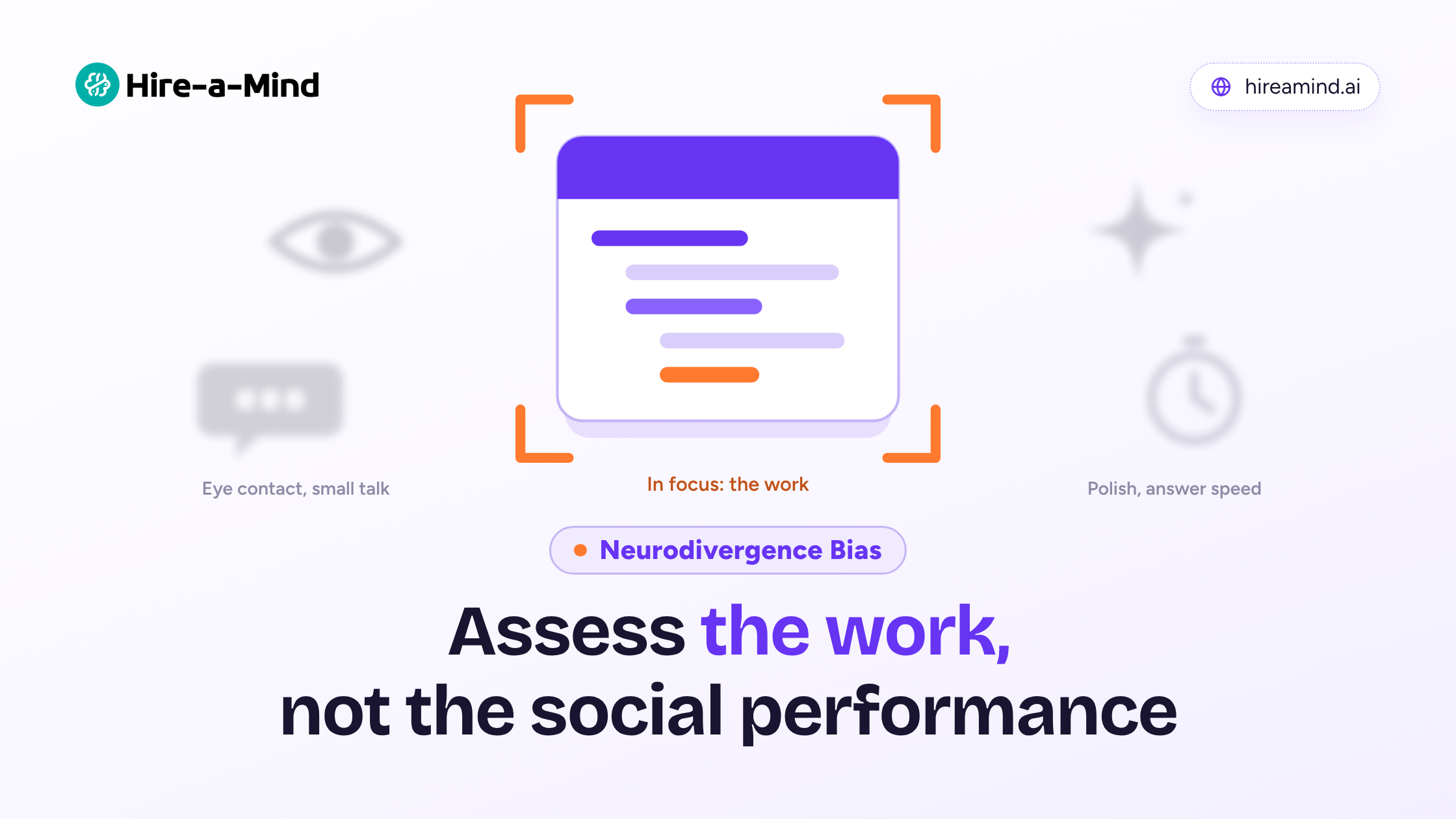
Neurodivergent Candidates and Interviews: Assessing the Work, Not the Social Performance
Conventional interviews can disadvantage neurodivergent candidates. Learn how to assess job-relevant skills without overvaluing social performance.
AI Hiring12 min read
On this page
- What happens when a strong candidate "interviews badly"?
- What are interviews actually measuring?
- Why can conventional interviews create barriers?
- Is an adjustment the same as lowering the standard?
- How do you assess the capability, not the performance of being interviewed?
- Do structured interviews solve the problem?
- What does a neuroinclusive interview look like in practice?
- Can AI interviews make hiring more inclusive, or add new bias?
- Where does Hire-a-Mind fit?
- What is the better question for hiring teams?
- What should hiring teams check before, during and after an interview?
- What does good neuroinclusive hiring ultimately look like?
- Frequently asked questions
Neurodivergent candidates can be fully capable of a job and still be marked down in a conventional interview, because many interviews measure social performance as well as job capability. The answer is not an easier interview. It is the same job standard, a better assessment method and less irrelevant signal.
Don't ask whether someone performed the interview well. Ask whether the interview gave you reliable evidence about whether they can do the work.
This article is practical guidance for hiring teams. It is not legal or medical advice, and it does not describe any one person's experience.
What happens when a strong candidate "interviews badly"?
Imagine a candidate for an engineering role whose CV shows years of closely relevant work. During the interview, they may take longer to begin an answer, interpret a vague question literally, or communicate differently from what the interviewer expects. Perhaps their eye contact differs from what the panel expects, they skip the small talk, or a hypothetical question is harder than one about real past work.
Afterwards, the scorecard says: "Not confident." "Poor communication." "Not a culture fit." "Didn't seem engaged." The candidate may or may not be neurodivergent. The scorecard would read the same either way.
The question is not whether those observations happened. It is whether they are valid evidence about the candidate's ability to do the job. The CIPD's neuroinclusion at work guide (2024) notes that interviews are generally more a test of social competence than of the ability to perform the specific tasks of a role.
The goal of an inclusive interview is not to lower the hiring standard. It is to make sure the standard measures the work, rather than someone's ability to perform a particular style of social interaction.
What are interviews actually measuring?
An interview is supposed to answer one question: can this person do the work? In practice, it often also asks: do they make eye contact, respond instantly, decode ambiguous questions and show confidence in a familiar way?
It helps to separate three things that are easy to blur together:
- Job performance. Can the candidate actually do the required work?
- The communication requirements of the role. Does this job genuinely need a particular kind of communication, and which kind?
- Interview performance. How well does the candidate perform inside the artificial setting of an interview?
These are not automatically the same. If a customer-support role requires clear spoken explanations, communication is job-relevant. But "maintained eye contact for most of the interview" is not evidence of customer-support ability. "Needed 20 seconds before answering" does not mean "cannot think under pressure". Those notes describe interview behaviour, not the work.
- Knowledge of the required technology
- How job-relevant: Usually
- A better way to get evidence: Ask about specific tools and decisions from past work
- Explaining a technical decision
- How job-relevant: Depends on the role
- A better way to get evidence: Ask for a walkthrough of a real decision, with time to structure it
- Experience solving a relevant problem
- How job-relevant: Usually
- A better way to get evidence: Ask for a specific past example: situation, action, result
- Handling a realistic work scenario
- How job-relevant: Often highly relevant
- A better way to get evidence: Give a written, realistic case and ask how they would work through it
- Structured reasoning
- How job-relevant: Often relevant
- A better way to get evidence: Score the steps and trade-offs in the answer, not the delivery
- Eye contact
- How job-relevant: Usually not
- A better way to get evidence: Leave it out of scoring
- Small-talk ability
- How job-relevant: Usually not
- A better way to get evidence: Leave it out of scoring unless the role is built on it
- Speed of answering
- How job-relevant: Not necessarily
- A better way to get evidence: Allow thinking time and score the substance of the answer
- Comfort with ambiguity
- How job-relevant: Only if the role requires it
- A better way to get evidence: If it matters, test it with a realistic task and say so upfront
- Confident presentation
- How job-relevant: Depends on the role
- A better way to get evidence: Define the communication the job needs and look for evidence of that
Ratings are general; decide per role whether each signal is evidence.
The problem is not that interviews contain signals. It is failing to tell useful ones from incidental ones. An interview can produce a lot of information without producing much useful evidence.
Why can conventional interviews create barriers?
The National Autistic Society's guide to autism and neurodiversity notes there is no agreed list of who is neurodivergent. Autism and ADHD are discussed most often; some descriptions also include dyslexia, dyspraxia, Tourette's syndrome and more, and many people have more than one. Much of the interview research focuses on autistic candidates, so the evidence below leans that way. Experiences vary widely, so these points affect some candidates, not all.
- Unpredictability. Unseen questions and fast topic changes can end up assessing how quickly someone adapts to interview conventions. The UK government's Buckland Review of Autism Employment (2024) says the traditional model of a generic job specification, an interview with strangers and unseen questions does not work well for autistic people.
- Communication is not one thing. The review also stresses that not all autistic people have communication difficulties; many communicate well.
- Ambiguous questions. "Tell me about yourself" or "What would you do if...?" can be surprisingly hard to interpret. The review notes hypothetical or abstract questions can add stress for autistic applicants.
- Social signalling. Eye contact, expression, tone, body language and small talk shape impressions. CIPD advises being aware of first-impression bias and not penalising unconventional body language. Norms for eye contact and directness also differ across cultures, so these signals can mislead for many candidates.
- Processing time. Some candidates need more time to form an answer. The review says that, for autistic people with information processing differences, this does not reflect cognitive ability or ability to do the role.
- Interview anxiety. An anxious performance can hide real capability.
- Panel dynamics. Several interviewers and interruptions add noise unrelated to the job.
Research points the same way. Surveying 225 autistic, 64 otherwise neurodivergent and 88 neurotypical UK adults, Davies and colleagues' study of hiring experiences (Autism, 2023) found all three groups were frustrated with the focus on social skills in recruitment and wanted more practical methods, such as work trials. Autistic participants also described a perceived pressure to mask, or hide, autistic traits to succeed.
Is an adjustment the same as lowering the standard?
No. An adjustment changes the conditions of assessment. Lowering the standard changes the job requirement. Keeping the two apart lets a team remove irrelevant barriers without compromising on the role. Adjustments are ordinary good assessment practice, not special treatment.
- Questions shared in advance
- What it changes: Reduces uncertainty
- What it does not change: The competency being assessed
- Extra processing time
- What it changes: Allows an answer to be formed
- What it does not change: The quality of answer expected
- Quiet interview space
- What it changes: Reduces distraction
- What it does not change: The job standard
- Written instructions
- What it changes: Clarifies the task
- What it does not change: The task itself
- Alternative response format
- What it changes: Changes how the answer is expressed
- What it does not change: The underlying competency
- Practical work sample
- What it changes: Changes the assessment method
- What it does not change: The capability required
Acas guidance on neuroinclusive recruitment advises training interviewers not to make assumptions from body language or social behaviour, sharing questions in advance where possible, using quiet spaces, and considering short paid work trials or practical assessments. Most of these steps cost little and will help all applicants.
Acas also gives an example of proportion. An autistic applicant for a shop assistant job asks to see the questions in advance. The employer shares most but, by agreement, keeps back one that tests handling unexpected questions. Irrelevant difficulty goes; what the job needs stays. Same job standard, better method.
How do you assess the capability, not the performance of being interviewed?
For every question, ask: what capability is this trying to measure, and does it measure that or mostly how well someone decodes it?
Instead of "Tell me about a time you demonstrated leadership", try: "Describe a project where you were responsible for coordinating people. What was the situation, what did you do, and what happened?" The structure is clearer and answers are easier to compare.
Instead of "What would you do if a customer became difficult?", try: "A customer has reported the same issue three times and is now asking for escalation. Walk us through how you would handle the case." Now the question tests reasoning against a realistic scenario.
This has research behind it. In a small initial study using mock interviews with 25 autistic and 25 non-autistic adults, Maras and colleagues' study of adapted interview questions (Autism, 2021) found employment experts rated autistic interviewees less favourably on standard questions. When questions were adapted to be clearer and more specific, ratings improved for both groups, particularly for autistic interviewees, and the gap narrowed.
The same applies to the scorecard. Instead of interpreting eye contact or "confidence", ask: "What evidence shows they can meet the communication requirement of this role?"
Do structured interviews solve the problem?
Structure helps, but only if it is built around relevant criteria. A structured interview that faithfully scores eye contact is still scoring eye contact.
A useful structured interview defines:
- what is being assessed
- why it matters for this role
- what good evidence looks like
- which questions test it
- how responses are scored
- what evidence supports each score
Swapping interviews for an "objective" test is no automatic fix either. A 2026 PLOS ONE study by Whelpley and colleagues compared online samples of autistic and neurotypical adults on general mental ability tests, personality inventories and situational judgement tests. All three produced meaningful differences unfavourable to autistic respondents. The authors call the findings preliminary and stress they do not imply a lack of job-relevant capability.
The lesson is not "use AI" or "remove interviews". It is to design every assessment around job-relevant evidence and know what each one measures.
What does a neuroinclusive interview look like in practice?
"Inclusive" only means something if it changes what happens in the room: candidates know what to expect and how to ask for adjustments without needing a diagnosis, and questions are clear and job-focused.
The Neurodiversity@Work Playbook (University of Washington, 2024) advises literal language, one question at a time, skill-specific questions, and telling candidates they can ask for extra time or rephrasing.
After the interview, do not ask, "Did I like this person?" Ask, "What evidence did we collect against each criterion?" Then ask, "What evidence is missing?" Missing evidence is a reason to find out more, not to assume the worst.
Can AI interviews make hiring more inclusive, or add new bias?
Either. AI doesn't remove interview bias simply because a machine is asking the questions. What matters is what it measures.
A well-designed AI interview can improve consistency:
- every candidate can receive the same core questions
- questions can be tied to criteria agreed in advance
- answers can be transcribed, reviewed and anchored to specific competencies
A poorly designed one can create new problems:
- scoring speaking style instead of substance
- treating speed of response as competence
- reading communication differences as lower ability
- relying on opaque behavioural signals
- automating decisions that should stay with people
These are design choices: an AI interview can score only the substance of answers against the team's criteria. Either way, ask any AI interview setup what you would ask a human panel: what is scored, is it job-relevant, can you see the evidence, and who decides? For more on where people stay in charge, see what an AI recruiter should and should not do and human-first AI recruitment.
Where does Hire-a-Mind fit?
This is one reason Hire-a-Mind is built around structured, evidence-backed evaluation rather than interview impressions alone. It is not a neurodiversity product, and it does not replace the adjustments or judgment above. It follows the same logic: define the criteria, ask structured questions, capture evidence and let people decide.
- Beacon defines the role's weighted criteria (Capability, Communication, Behavioral, and Potential & fit) before anyone is assessed. The team decides upfront how much communication matters for the role.
- Sift checks each CV against those same weighted criteria, with the CV lines behind every score.
- Scout runs structured AI Interviews by text or voice, using configurable questions and follow-ups built around the competencies the hiring team wants to evaluate. Scout evaluates the substance of each answer against the configured assessment criteria, with the resulting score linked to the transcript. It does not score tone, speaking pace, fluency or other vocal characteristics. Answer time is configurable, so hiring teams can set an appropriate response window for each interview, and answer speed itself does not affect the score. Once a candidate finishes an answer, Scout moves to the next question or, when configured, asks a relevant follow-up.
- Human interviews stay part of the process. They are scheduled on Google Meet, and their transcripts are assessed against the same criteria.
- Evaluation brings screening, AI interview and human interview evidence together. Reviewers score independently, and missing scores show as missing rather than zero.
AI never rejects a candidate: a low score routes them to a person. The AI recommends. People decide.
What is the better question for hiring teams?
Instead of "Did this candidate interview well?", ask: "Did this interview give us good evidence about whether this candidate can do the job?"
A candidate can have an uncomfortable interview and still show excellent capability. Another can interview confidently and provide weak evidence. Neither impression should decide the outcome. The same question sits behind moving away from gut-feeling hiring and checking for name bias in hiring.
The answer to subjective hiring isn't to remove people from the decision. It's to give people better evidence to decide from.
What should hiring teams check before, during and after an interview?
Before
- Define the actual job competencies.
- Separate essential requirements from preferences.
- Decide what evidence will demonstrate each competency.
- Tell candidates what the interview format will be.
- Make adjustment options visible.
During
- Ask structured, job-relevant questions.
- Give reasonable processing time.
- Don't score eye contact or social style unless the job directly requires it.
- Record evidence rather than impressions.
After
- Score against the criteria you defined beforehand.
- Separate evidence from interpretation.
- Record missing evidence as missing, rather than assuming a negative.
- Review whether impressions affected the scores.
- Keep the final decision explainable.
What does good neuroinclusive hiring ultimately look like?
It is not everyone getting exactly the same interview. It is everyone getting a meaningful opportunity to show the capabilities the job requires.
Fairness does not always mean identical conditions. It means the assessment is relevant to the work. Clear questions, predictable formats and time to think often help every candidate show what they can do.
The goal isn't to make every candidate perform the same way. It's to make sure every candidate is assessed on the capabilities the job actually requires.
Assess the work, not the performance of being interviewed.
Define what the role requires, ask structured questions, capture the evidence and make the final decision with people in charge.
The AI recommends. People decide.
Frequently asked questions
What does neurodivergent mean in the workplace?
- Neurodivergent describes people whose information processing differs from what is considered typical. Autism and ADHD are discussed most often; some descriptions include dyslexia, dyspraxia, Tourette's syndrome and others, and many people have more than one. A hiring process built around one way of thinking and communicating can miss capable people.
Why can traditional interviews disadvantage neurodivergent candidates?
- Conventional interviews often reward quick answers, small talk, expected eye contact and decoding vague questions. For some neurodivergent candidates, those demands say little about the job but shape impressions. CIPD describes interviews as generally more a test of social competence than of job tasks.
Are structured interviews better for neurodivergent candidates?
- They can help, because clear, consistent questions reduce unpredictability and make answers easier to compare. But structure only helps if it is built around job-relevant criteria. A structured interview that still scores eye contact or delivery style repeats the problem in a more organised form.
Should employers give interview questions in advance?
- Often, yes. Acas advises letting applicants see questions in advance where possible, which usually helps all candidates. The exception is a question testing something the role genuinely needs, such as handling the unexpected. Even then, most questions can usually be shared.
Does accommodating neurodivergent candidates mean lowering the hiring standard?
- No. An adjustment changes the conditions of the assessment, such as timing, format or environment. Lowering the standard would change the job requirement itself. Sharing questions or allowing processing time keeps the same competencies and expected quality, while removing difficulty unrelated to the work.
What should interviewers avoid when interviewing neurodivergent candidates?
- You often won't know who is neurodivergent, so apply this to every interview. Avoid scoring eye contact, body language or small talk unless the role requires them, avoid vague or multi-part questions, and don't read a pause as weaker thinking. Don't try to work out whether someone is neurodivergent, or ask.
Can AI interviews make hiring more inclusive?
- They can, if they are designed well. Questions can be tied to criteria agreed in advance, with transcripts people can review. Hire-a-Mind's Scout, for example, scores the substance of answers, not tone, pace or fluency, and answer speed does not affect the score. Teams should still check what any system measures.
Can AI interviews introduce new forms of bias?
- Yes. An AI interview can score speaking style instead of substance, treat speed as competence or rely on signals nobody can inspect. Ask what each tool measures, whether speed or vocal style affect scores, whether you can see the evidence, and whether people decide.
How can employers assess neurodivergent candidates based on job-relevant skills?
- Define what the role requires and what evidence would show it. Use clear questions about real past work, realistic written scenarios or practical work samples. Score against the criteria, record evidence rather than impressions, and treat missing evidence as a reason to ask more.
Should candidates disclose that they are neurodivergent?
- That is a personal choice. Acas guidance notes that nobody has to tell their employer they are neurodivergent. Employers can help by making adjustments easy to request without a diagnosis and by designing an accessible process for everyone. Rules differ by country, so this is not legal advice.
- Neurodiversity in Hiring
- Neurodivergent Candidates
- Structured Interviews
- Interview Bias
- AI Interviews
- Candidate Evaluation
- Hire-a-Mind
- Neurodivergence Bias
Keep reading
All articles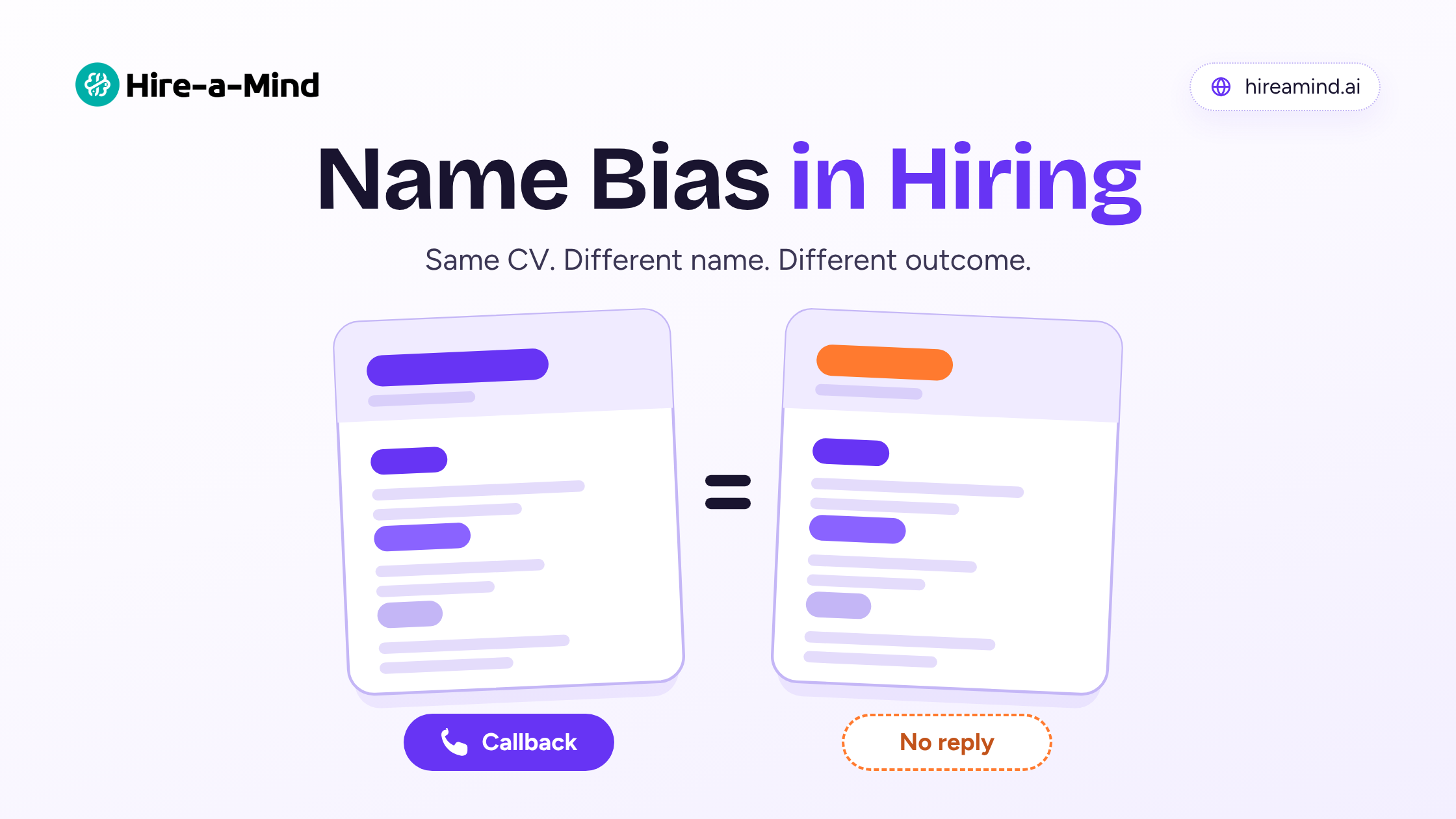
AI Hiring
Name Bias in Hiring: What CV Studies Show, and How to Check Your Shortlist
Name bias in hiring is well documented. See what CV studies found, why AI screening can repeat it, and a practical checklist for your own shortlist.
AI Hiring
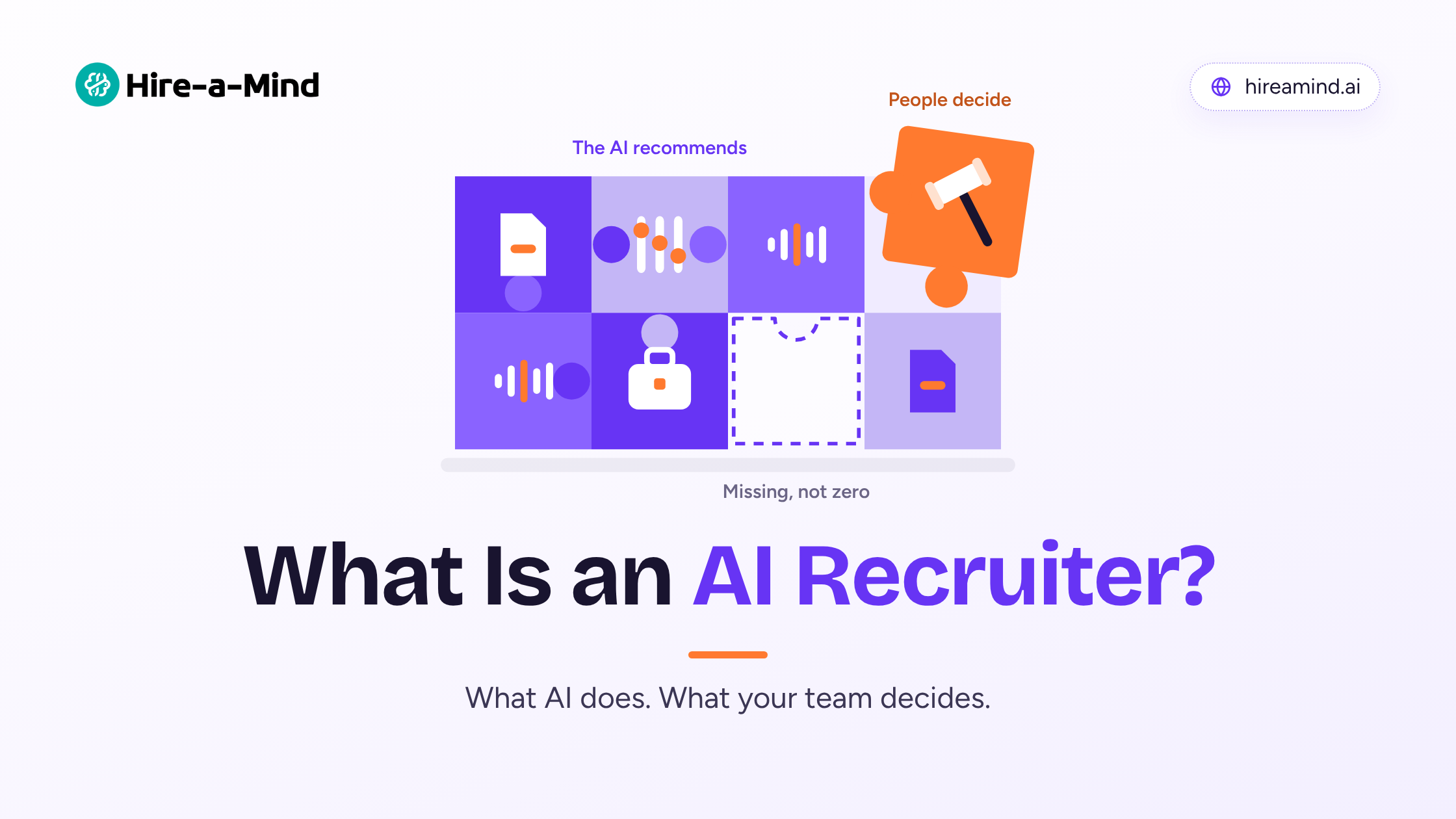
What Is an AI Recruiter? What AI Recruiting Agents Can Do and What Your Team Still Decides
An AI recruiter screens CVs, runs structured interviews and surfaces evidence. Learn what AI recruiting agents should do and what your team still decides.
AI Hiring
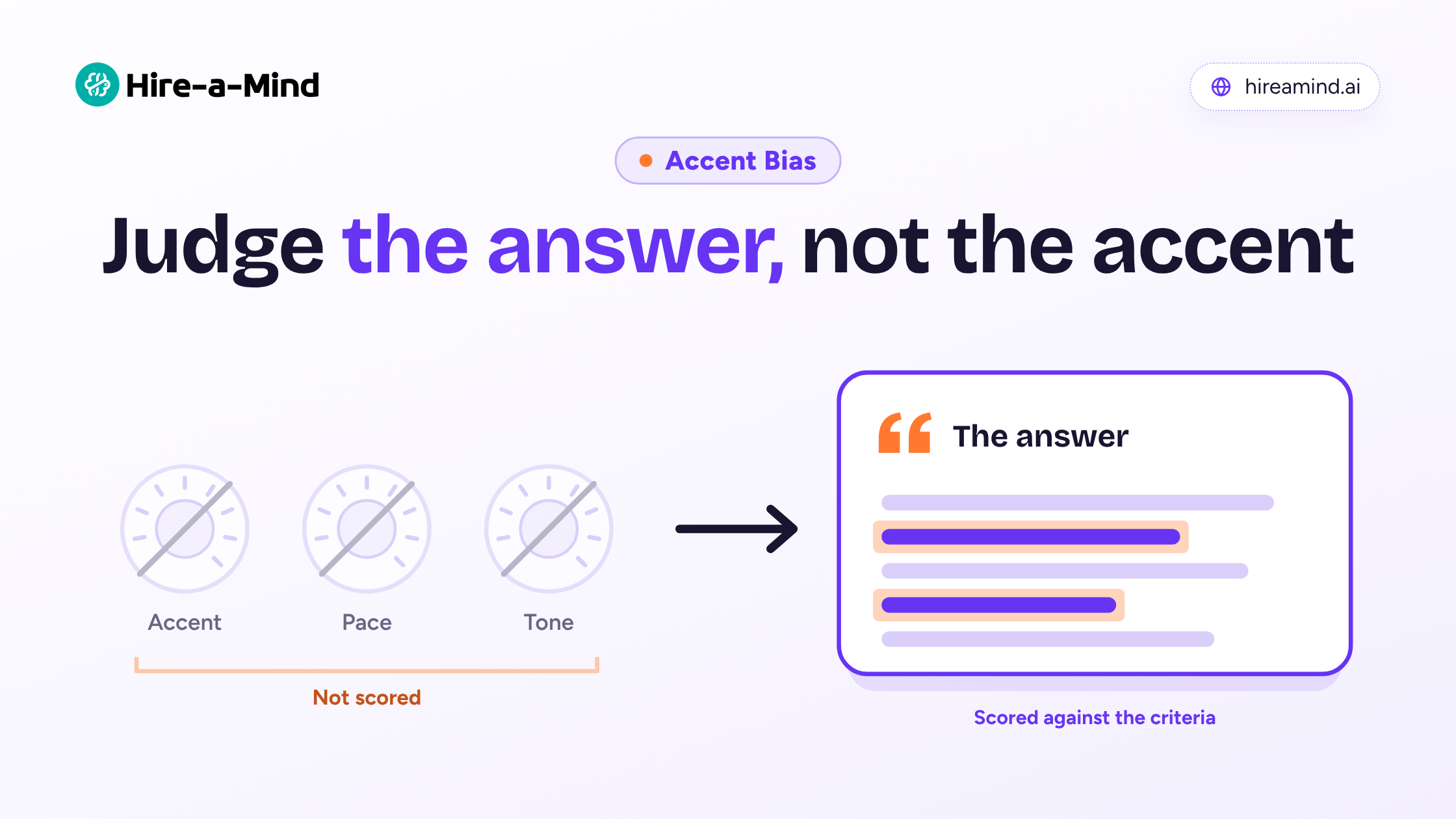
Accent Bias in Interviews: Judging the Answer, Not the Accent
Accent bias can lower interview scores even for identical answers. See what research shows and how to assess communication without judging the accent.