
Name Bias in Hiring: What CV Studies Show, and How to Check Your Shortlist
Name bias in hiring is well documented. See what CV studies found, why AI screening can repeat it, and a practical checklist for your own shortlist.
AI Hiring10 min read
On this page
- What is name bias in hiring?
- How do researchers measure name bias?
- What have CV studies found?
- Why do names act as a proxy?
- Can AI CV screening repeat name bias?
- Does hiding names fix name bias?
- Where does name bias enter, and how can you check for it?
- How do you check your shortlist for name bias?
- What should you record?
- Where does Hire-a-Mind fit?
- Frequently asked questions
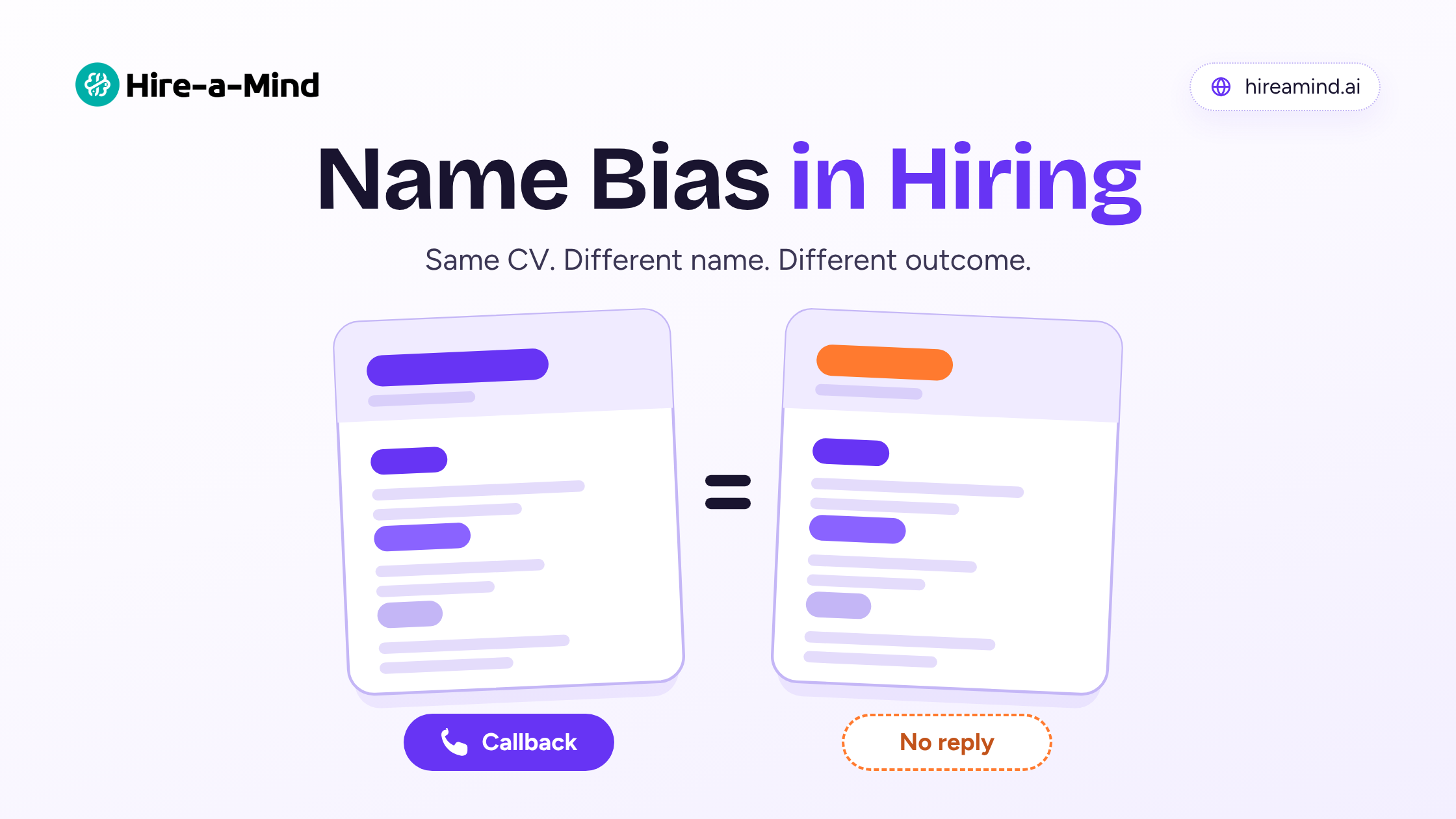
Name bias in hiring happens when a candidate's name affects how their application is judged, even when otherwise comparable candidates have similar skills and experience. Field experiments in several countries have found it repeatedly. The practical response is to set criteria before reading CVs, then test your shortlist with a name-swap check.
A name says almost nothing about whether someone can do the job. If it changes who gets a call back, the process is measuring the wrong thing.
This article summarises published research and offers practical steps. It is not legal advice. Rules on hiring discrimination vary by country, so speak with employment counsel about your own situation.
What is name bias in hiring?
Name bias in hiring is the tendency to rate, shortlist or contact candidates differently because of the name on their CV, rather than the evidence in it.
Names carry signals. A reader may infer, rightly or wrongly, someone's race or ethnicity, gender, religion, region or country of origin, or social background. It is usually not deliberate. It shows up as a faint sense that one candidate seems a "better fit".
The studies below measure how employers respond to names, not anything about the people who carry them. That response is something a hiring team can change.
How do researchers measure name bias?
Most evidence comes from correspondence studies, also called callback studies. Researchers send equally qualified applications to real job adverts, changing mainly the name, then count which ones receive a call back or interview invitation.
This design isolates the name, but it has limits:
- It measures the first step. Callbacks are not hires, though a missed callback usually ends the process.
- Names carry mixed signals. A name can suggest social class or migration history as well as ethnicity.
- Results depend on context. Time, place, sector and role all affect the size of the gap.
What have CV studies found?
The pattern holds across countries and decades, though the size of the gap varies.
United States
A landmark study by Marianne Bertrand and Sendhil Mullainathan (NBER working paper, 2003; American Economic Review, 2004) answered job adverts in Boston and Chicago with fictitious CVs. White-sounding names received 50% more callbacks. A stronger CV also helped white names far more than African-American names. Employers advertising as an "Equal Opportunity Employer" discriminated as much as others.
Nearly two decades later, Patrick Kline, Evan Rose and Christopher Walters ran a far larger test, "Systemic Discrimination Among Large U.S. Employers" (NBER 2021; Quarterly Journal of Economics 2022). Across more than 83,000 applications to 108 large employers, distinctively Black names reduced the chance of contact by 2.1 percentage points. About a fifth of firms accounted for nearly half of the lost contacts.
Their follow-up, "A Discrimination Report Card" (NBER 2024; American Economic Review), graded 97 large firms and found gaps that varied widely between them. The lesson: name bias is not fixed, and it depends heavily on each organisation's process.
Canada
Philip Oreopoulos tested employer responses in the Toronto area (American Economic Journal: Economic Policy, 2011). CVs with English-sounding names received callbacks about 16.0% of the time. When only the name was changed, the rate fell to about 11.5% for Indian names, 11.0% for Pakistani names and 11.3% for Chinese names. Overall, English names were 39% more likely to get a call back.
United Kingdom
The GEMM study by Valentina Di Stasio and Anthony Heath at Nuffield College, Oxford (2019) applied to nearly 3,200 jobs between November 2016 and December 2017. Every minority applicant was British-born or had arrived in the UK by age six. Ethnicity was signalled through the name, alongside a language linked to the country of origin. On average, 24% of applicants from the majority group received a positive response, and minority applicants had to send 60% more applications to get the same result. Applicants with origins in Muslim-majority countries faced barriers whether or not they mentioned religion. The authors found no progress over roughly 50 years for Caribbean and South Asian applicants as a whole.
Australia
Mladen Adamovic and Andreas Leibbrandt sent more than 8,000 applications (Industrial Relations, 2025). Before COVID-19, 25.3% of applicants with English names received a positive response, compared with 13.1% for Chinese names and 13.2% for Indian names. During the pandemic, the rates for Chinese and Indian names fell further, to 9.8% and 9.6%.
India
Sukhadeo Thorat and Paul Attewell (Economic and Political Weekly, 2007) sent three equally qualified applications to each job advert, with an upper-caste Hindu name, a Dalit name or a Muslim name. They concluded that discrimination already operates at the first stage of hiring.
- Bertrand & Mullainathan (2003/2004)
- Where: Boston and Chicago, US
- What changed: White- vs African-American-sounding names
- Headline finding: White names got 50% more callbacks
- Kline, Rose & Walters (2021/2022)
- Where: 108 large US employers
- What changed: Distinctively white vs Black names
- Headline finding: Black names lowered contact by about 9%
- Kline, Rose & Walters (2024)
- Where: 97 large US employers
- What changed: Firm-by-firm comparison
- Headline finding: Gaps ranged from about 3% to about 24%
- Oreopoulos (2011)
- Where: Toronto, Canada
- What changed: English vs Indian, Pakistani and Chinese names
- Headline finding: English names 39% more likely to get a call back
- Di Stasio & Heath, GEMM (2019)
- Where: Great Britain
- What changed: Majority vs minority ethnic names
- Headline finding: Minority applicants needed 60% more applications
- Adamovic & Leibbrandt (2025)
- Where: Australia
- What changed: English vs Chinese and Indian names
- Headline finding: 25.3% vs 13.1% and 13.2% positive responses
- Thorat & Attewell (2007)
- Where: India
- What changed: Upper-caste Hindu, Dalit and Muslim names
- Headline finding: Discrimination at the first stage of hiring
Figures are rounded and taken from each study's published summary. Each links to its source above.
Why do names act as a proxy?
A name works as a shortcut that pulls in assumptions about language, culture, visa status or "fit", none of which the CV tested. Other details can do the same: an address or postcode, a school, a career gap, or a photo.
This is why bias often survives good intentions. A reviewer who sincerely values diversity can still give a CV slightly less attention. Over hundreds of CVs, small differences add up to a different shortlist. This is the case for moving away from gut-feeling hiring towards criteria that everyone scores against.
Can AI CV screening repeat name bias?
It can. AI tools learn patterns from data, and hiring data reflects past human decisions.
In 2024, researchers at the University of Washington, Kyra Wilson and Aylin Caliskan, tested three text-embedding models on more than 500 CVs and job descriptions across nine occupations (AIES 2024; UW summary). Only the names varied. White-associated names were preferred in 85.1% of tests and Black-associated names in 8.6%. Male-associated names were preferred in 51.9% of tests and female-associated names in 11.1%. In comparisons between Black male and white male names, the Black male names were never preferred.
This was a research setting, not a test of any particular hiring product. Still, it shows how the risk works:
- Learning from past decisions. A model trained to copy who was hired before can copy the biases in those decisions.
- Learning from proxies. Removing the name may not be enough if a model can pick up the same signal from address, school or wording.
- Hidden reasoning. A score without reasons is hard to question, so a bias can go unnoticed.
The practical answer is not to avoid AI, but to require that every AI score is tied to the role's criteria, explained with CV evidence, and reviewed by a person. That is the idea behind human-first AI recruitment. It is also a useful lens when deciding what an AI recruiter should and should not do.
Does hiding names fix name bias?
Sometimes, but the evidence is mixed. Blind or anonymised CV screening can stop some first impressions. It does not remove other proxies, or bias later in interviews and decisions.
A French trial shows why results can surprise. Luc Behaghel, Bruno Crépon and Thomas Le Barbanchon evaluated a public employment service programme that anonymised CVs (American Economic Journal: Applied Economics, 2015). Firms chose whether to take part. Among those that did, the firms that received anonymous CVs became less likely to interview and hire minority candidates. The authors linked this to which firms opted in, and to anonymisation hiding context that might otherwise have softened negative signals.
Hiding names can be one useful tool, but it does not replace clear criteria and regular checks.
Where does name bias enter, and how can you check for it?
Bias can enter at any stage, not only the first read of a CV.
- Defining the role
- How name bias can enter: Vague asks such as "culture fit" or "native speaker" invite assumptions
- How to check it: Write job-related criteria and weights before any CV is opened
- CV screening
- How name bias can enter: The name, address or school prompts a shortcut
- How to check it: Score every CV against the same criteria and record the evidence line
- Shortlisting
- How name bias can enter: Gut feel overrides the scores
- How to check it: Compare the shortlist with the scores and ask for a reason for each override
- Interviews
- How name bias can enter: Candidates get different questions or a different tone
- How to check it: Ask the same questions in the same order and score answers against the criteria
- Final decision
- How name bias can enter: One loud opinion wins, or missing evidence is read as weakness
- How to check it: Have reviewers score independently and keep one decision record
- AI tools
- How name bias can enter: Patterns learned from past decisions or proxies
- How to check it: Test with matched CVs and check that explanations cite job-related evidence
How do you check your shortlist for name bias?
You do not need a research team for this. The checklist works for human reviewers and AI tools.
- Set the criteria first. Agree on must-haves, nice-to-haves and weights before reading CVs, and what evidence counts for each.
- Score against the criteria, not overall impressions. Each score should point to a specific line in the CV.
- Run a name-swap test. Copy a small sample of CVs, changing only the name to ones associated with different groups. Have them scored again, ideally by reviewers who do not know which copy is which, or run them through your AI tool. Compare the results.
- Check for other proxies. Look at whether address, school, career gaps or photos are swaying scores in ways the criteria do not justify.
- Review overrides. When someone moves a candidate above or below their score, ask for a written, job-related reason.
- Read the explanations. "Not a fit" is not a reason. A good explanation names the criterion and the evidence.
- Look at each stage, not just hires. If you collect voluntary diversity data, and only in line with local law and privacy rules, compare how groups move through each stage.
- Repeat it. Run the check again after changing the role, the criteria, the reviewers or the tools.
A name-swap test has limits. Small samples are noisy, so one difference is a prompt to look closer, not proof of bias. Its value is turning a vague worry into a specific question.
What should you record?
An evidence trail shows why each candidate moved forward or did not. For each role, it is usually worth keeping:
- The criteria and weights as they stood when screening began.
- Each score with its evidence, such as the CV line or interview answer behind it.
- Who scored what, a person or an AI tool.
- Overrides and their reasons.
- The final decision, who made it, and why.
- Your check results, including any name-swap tests and what you changed.
This usually works well when screening, interviews and evaluation share one record, the thinking behind a connected hiring workflow.
Where does Hire-a-Mind fit?
Hire-a-Mind is an AI hiring platform built around structured, evidence-based decisions. It does not replace the checks above, but it builds their structure into everyday hiring. That does not make a hiring process bias-free; it makes the reasoning easier to inspect, test and challenge.
- Beacon turns a role into weighted criteria (capability, communication, behavioral, and potential and fit) that screening, interviews and the final decision all score against.
- Sift checks each CV against the same weighted criteria, and every score comes with the lines from the CV behind it. AI never rejects a candidate: a low score sends the CV to a person.
- Scout runs AI Interviews with the same questions in the same order, with scores linked to the transcript.
- Evaluation has reviewers score independently, shows missing scores as missing rather than zero, and keeps one decision record.
The AI recommends. People decide. You can read more about our approach on the compliance page.
Want a shortlist you can explain? Start with one role.
Set your criteria once, score every CV against them with the evidence shown, and keep one record of who decided what, and why.
The AI recommends. People decide.
Frequently asked questions
What is name bias in hiring?
- Name bias in hiring happens when a candidate's name affects how their application is judged, even when otherwise comparable candidates have similar skills and experience. Names can act as signals of race, ethnicity, gender, religion, region or social background, so reviewers may react to assumptions instead of qualifications, often without realising it.
Is name discrimination in hiring still happening?
- Recent studies in several countries suggest it is still occurring, although the size and form of the effect vary by context. A large US study found distinctively Black names reduced employer contact by about 9%, and a 2019 UK study found minority applicants needed 60% more applications.
What is the classic study on name bias?
- A widely cited study is by Bertrand and Mullainathan, published in the American Economic Review in 2004. They sent fictitious CVs to job adverts in Boston and Chicago and found that white-sounding names received 50% more callbacks than African-American-sounding names, even when the CVs were equally qualified.
Does name bias happen outside the US?
- Yes. Studies have found similar patterns in Canada, where English names were 39% more likely to get a call back, and in Britain, Australia and India. The groups affected vary by country, but the pattern is similar: equally qualified applicants receive fewer responses because of the name on the CV.
Can AI resume screening be biased by names?
- It can. A 2024 University of Washington study found that three text-embedding models preferred white-associated names in 85.1% of tests. AI tools learn from data, and data often reflects past human decisions. Scores tied to clear criteria, explained with CV evidence and reviewed by people, are easier to check.
Do blind or anonymous CVs remove name bias?
- Not always. Removing names can reduce some first impressions, but other proxies such as address or school remain, and bias can return at interview. A French trial found that firms receiving anonymous CVs became less likely to interview minority candidates. Clear criteria and regular checks are still needed.
What is a name-swap test?
- A name-swap test checks whether names change outcomes in your own process. You copy a sample of CVs, change only the names, and have them scored again by people or by an AI tool. If scores differ, look closer at your criteria, reviewers or tools to find out why.
How often should we check our shortlist for name bias?
- A simple rhythm works for most teams: check when a new role opens, whenever criteria, reviewers or tools change, and at regular intervals for roles you hire for often. Small, frequent checks usually catch drift earlier than a single large review once a year.
Is name bias in hiring illegal?
- In many countries, treating candidates differently because of race, ethnicity, religion, sex or national origin is restricted by employment law, and names can act as a proxy for those traits. Rules differ by country and region. This article is not legal advice, so speak with employment counsel about your situation.
Can software alone remove name bias from hiring?
- No software can do that on its own. Hire-a-Mind helps teams set structured criteria in Beacon, score every CV against the same criteria with explained reasons in Sift, and keep an evidence trail. People make every decision, and checks such as a name-swap test are still worth running.
- AI Hiring
- Hiring Bias
- Name Bias
- CV Screening
- Structured Hiring
- Hire-a-Mind
Keep reading
All articles
AI Hiring
What Is an AI Recruiter? What AI Recruiting Agents Can Do and What Your Team Still Decides
An AI recruiter screens CVs, runs structured interviews and surfaces evidence. Learn what AI recruiting agents should do and what your team still decides.
AI Hiring
AI Hiring for Recruitment & Staffing Agencies: What It Should Actually Do
Learn how AI hiring helps recruitment and staffing agencies handle more roles, screen CVs, run interviews and make evidence-backed client recommendations.
AI Hiring
Accent Bias in Interviews: Judging the Answer, Not the Accent
Accent bias can lower interview scores even for identical answers. See what research shows and how to assess communication without judging the accent.